
Trying to get to St. Vincent
 August 3rd, 2010 |
  Author:
 Current Position: 14°36.04'N, 61°4.21'W
Distance sailed since last post: 237 nautical miles
YouTube Link: Leaving Gaudeloupe for St. Vincent
We stayed in St. Martin a few days to get some rivets sorted out at the front end of the boom, and the, with Tropical Storm Colin on the way, we decided we should get a move on and sail to St. Vincent, which would be a 24 hours sail.
Well, all started well, and we even had the spinnaker up.
Then the wind got up and we tried to adjust the spinnaker when BAM! the block for the spinnaker sheet blew out! Not only did it do that, it also ripped through the two lifelines, and sliced the spectra line in two.
Next think we new the spinnaker was wrapped around the forestay, and the harder we tried to unwrap it, the more wrapped it got. By now it was getting towards dark, the wind was at 25 knots, and we were 15 miles downwind of Dominica.
We decided the prudent thing to do was to motor to Dominica and see if we could find some shelter in the lee of some cliffs that would allow us to sort it out.
The only thing was, with the spinnaker ballooning out from the forestay, we had an awful lot of drag. In fact, the more the wind blew, the slower we went so at one point we were literally not moving at all, even with the engines at 2500 rpm.
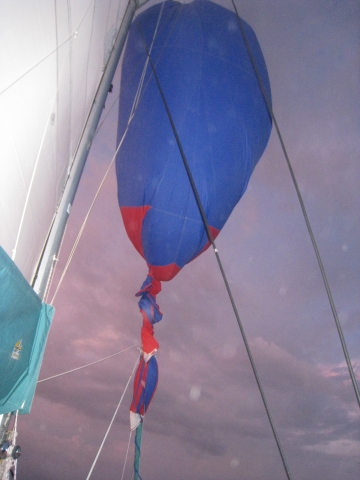
Hard to sail to wind with that holding you back!
We eventually arrived at Dominica at 10pm and found a quiet place to anchor. We still couldn’t unwrap it, so we went to bed.
Next morning we motored down the coast to Roseau where we found a nice guy named Jerry who, along with a flat calm, enabled us to sort it all out within an hour.

Noel hoisting Jerry up the mast to untangle the spinnaker
However, Roseau, the capital of Dominica, has absolutely NO chandlery supplies, so we then sailed over to Martinique to get some fittings.
Finally, from there we were able to set sail for Grenada.
 Posted in
  Tags:
Tags: 
Our First Night Passage: BVI to St. Martin
Current Position: 18°1.91'N, 63°5.71'W
Distance sailed since last post: 77 nautical miles
YouTube Link: Sailing at Night
Conditions couldn’t have been more perfect! The wind was in the right direction, so we sailed close hauled the entire way, and needed only one 2 mile tack at the end to take us straight into Simpson Bay. We had a clear sky, with just some scattered clouds, and a bright, bright full moon that lit up the whole sea. The waves were gentle, just one to two meters, and the boat behaved nicely – I didn’t even have to change a fuel filter.
Since we had fair winds and were able to keep both sails up, we just used the motor at low revs (2000 rpm) to give us an extra couple of knots, and to enable us to point that little bit higher.
So we made good time, arrived at 7:30 am for a total passage time of 14 hours from Spanish Town. And then we got some sleep before checking in with Customs.
First Week Living Aboard
Current Position: 18°29.54'N, 64°21.45'W
Distance sailed since last post: 16 nautical miles
Here is a 4 minute video after our first full week on board:
YouTube Link: First Week Onboard
Sorry about the wind noise, will try to do better next time!
Our Tour of Brazil and Peru
Brazil and Peru were interesting – but huge. Everytime we went to a new place, it was a full day’s traveling.
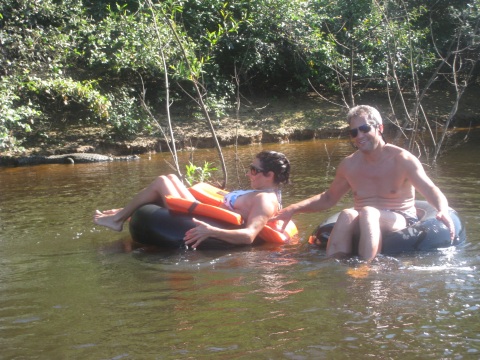
Floating past caymans in the Pantanal, Brazil
We first went to Campo Grande, where we met someone who introduced us to Pousada Santa Clara in the Pantanal, which was excellent. Cheap, but good room, full board and excellent guides. We did a river trip, tube floating among the caymans, walked through the forest and saw an anteater, monkeys, racoons, parakeets, capybaras and loads of birds. We also fished for yellow-bellied piranhas and caught one each, which were then fried for us that evening – very tasty but very small and lots of bones!
From there we went to the youth hostel in Bonito. The hostel was great. We had a private room, there was a swimming pool, and they organized all the tourist trips. We did a snorkel float in both Rio Sucuri, and Rio de Prata – freshwater rivers with astounding clarity. But the trips were very overpriced and very tourist oriented. Apparently everything is government controlled, and you got treated like children on a school trip.
Next was Foz Iguazu which was simply amazing – huge, huge waterfalls that we saw from both the Brazillian and Argentinian sides. Both were equally spectacular.
We then visited Ceu’s friend Matheus in Belo Horizonte – a clean modern city with such steep hills that you really need good breaks on your car! It was like going on a roller coaster. We had a lovely visit with him and his mother and brother – and got to drink the Brazillian specialty drink called ‘Chop’ (pronounced ‘Shop’) which, believe it or not, consists of just the FOAM from an ordinary beer! Absolutely crazy! Matheus showed us his city, took us to the best restaurants and, naturally, we watched the Brazillians play at the World Cup. Nothing else to do, since the entire country closes when a game is on. Even the museums shut until after the game.
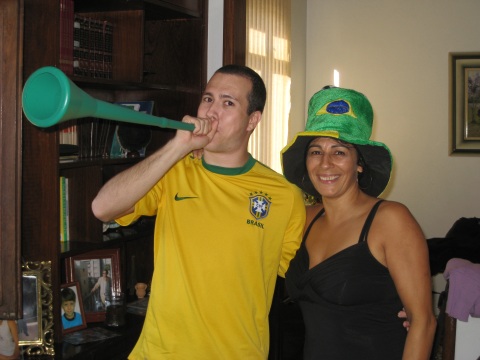
Matheus and Ceu cheering for Brazil's victory over Chile at the World Cup
From there we went to Rio, and stayed in a rather basic youth hostel at Ipanema. We ate in the restaurant across from ‘The Girl from Ipenema’ restaurant, which is where the song was written. We toured the largest Favela which is run by a drug gang – and as a result has virtually no crime, as they want to keep it a safe place for people to come and buy drugs!
Of course we walked both Copacobana and Ipanema beaches, along which there a several public, open-air, work-out gyms. They consist of a frame of pull up and other bars and one even includes weights. They are totally free and get well used. We often saw people there with a personal trainer coaching them.
Throughout the trip we had sunshine, warm weather, and no rain.
A 4 hour flight took us to Lima, Brazil. First stop was a Ceviche restaurant in Miraflores – IIt was so good when we went there on our first pass through, (on the way to Brazil from BVI), that we went back there a second time. Lima itself, however, was rather uninspiring. Very run-down.
From there we started our Peru tour – the floating islands of Uros in Lake Titicata, the highest navigable lake in the world. It is huge – and 3,800 meters high. The floating islands are made of reeds, the houses on them are made of reeds, the cooking fires are fueled by reeds, the farmed guniea pigs (yes, they eat them) feed on reeds, and even the children’s jungle bars are made of … reeds.
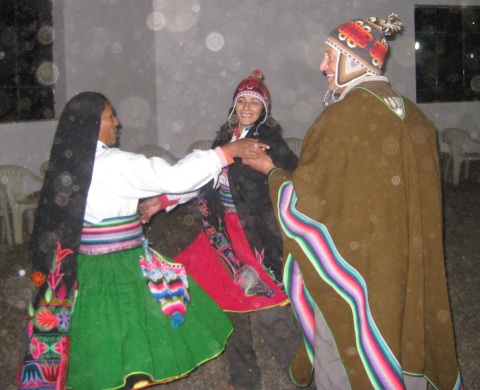
Dancing at the Lake Titicaca Party
We stated overnight with a family on Anantamis island, and walked up to the peak of Pacha Mama, 4,200 feet. Then we donned native clothes and went to a party. The weather was curious – the bright sunshine was hot, but the air was cold, so you would be warm on one side of the body, and cold on the other!. The nights went down to about freezing point.
On the bus ride from the town of Puno (Lake Titicaca) we visited some Inca sites and then arrived at the Inca capital, Cusco. Of course, this is now 75% tourist driven, but still a pleasant town of about 300,000 people.
First visiting the Sacred Valley, we then went to Olaytamba to start the Inca trail.
Here was our first surprise – we had a private tour, just the two of us – plus SIX porters and our guide, Marco Antonio. The guides carried our stuff, put up our tents, and cooked us meals that were served at a table with a table cloth! Marco was excellent, so enthusiastic about the Incas – he has been guiding for 20 years, but was still taking as many photos as us, as the shadows and lighting were always different.
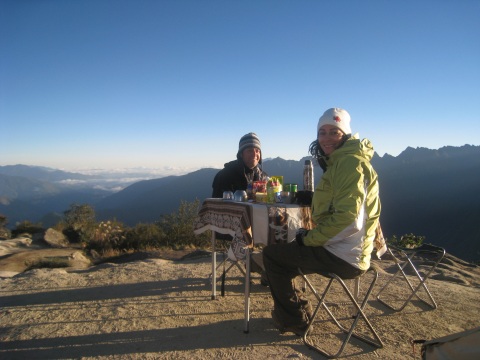
Breakfast at the top of the Inca Trail
The trail was fairly straight forward, including the second day which took us back up to 4,200 meters again, to cross the Dead Woman’s Pass. Along the way we saw numerous Inca terraces and buildings, and lots of flowers, plants and birds. Marco identified them all.
He even took us to a couple of un-restored Inca sites which, to us, was probably the highlight of the trail. These are off the trail and, in fact, Marco had only been to one of them twice before. First you have lots of jungle and then, suddenly, under the jungle you see terraces, and houses, and store rooms, and temples and fountains – all grown over by trees and vines. Just like ‘Raiders of the Lost Ark’! It does make you realise how much restoration it takes to bring a place like Machu Picchu to the condition it is now in.
Finally we arrived at Machu Picchu – and it is just as spectacular as in the photos. We also climbed up Waynu Picchu, which was steep, but not too bad until the very last bit where it is definitely pretty hairy. For me, anyway; Ceu (Mountain Goat) seemed to be just fine with it!
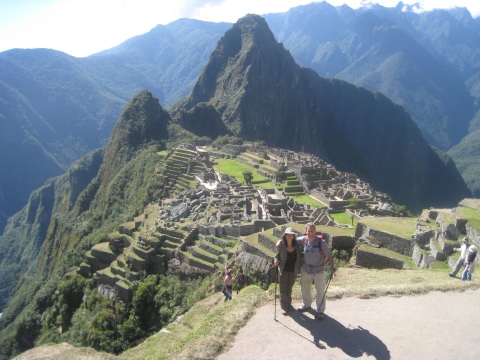
First sight of Machu Picchu
Again, the weather was fantastic. During the daytime we were hiking in sunshine with T-shirts. At night it went down to a few degrees above freezing. We had frost one morning. In the distance we could see glaciers and snow in the highest peaks, over 5,500 meters.
The final stop was the Amazon at Puerto Maldonado, elevation about 200 meters – yet 2,000 km from the sea. Now, here was the biggest surprise. Here we were, in the Amazon rain forest, just 12 degrees south of the Equator, and it was COLD. 11 degrees cold to be precise. Bear in mind that the lodge had no walls, no ceilings, and no heating. That means it was 11 degrees for 72 hours straight.
Fortunately Marco had warned us, so we took with us our fleeces and hats (we could bring with us only a sub-set of all our gear). Other travelers were not so fortunate, and had only their summer clothes, so they were even more miserable than us.
Still, we had tours through the forest, seeing a family of Giant Otters, a few blue and yellow macaws, lots of squirrel and howler monkeys, but no snakes. I guess one good thing about the temperature was the lack of mosquitoes and insects.
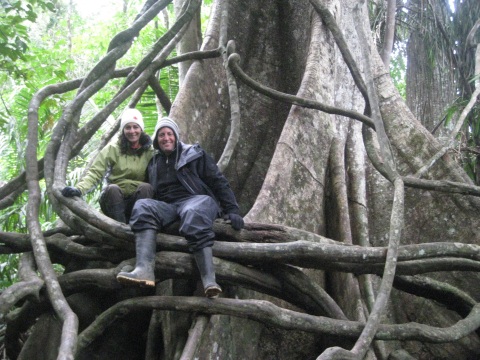
In the Amazon rain forest
So that was it, a full month in South America, and then back to BVI to board our boat. A great adventure.
The First Two Weeks of Life On Board
So, it finally happened.
We got off the plane with all six items of luggage safely with us. After all the planning, dreaming, and packing we had finally arrived in Tortola. We loaded all our stuff into the boat, and stepped aboard. This was it, the start of our adventures in Life Part 2.
In a way it was a bit weird, as we only had 12 days onboard before we would have to leave again. Which meant that we couldn’t really unpack, so it was more like a chartered boat than our own. But it actually worked out well, as it gave us a two week peaceful shakedown in the Beautiful British Virgin Islands before we would actually take off on the real adventure.
We kicked into holiday mode. We also had Ceu’s daughter Jessica with us for the first week. So it was some idyllic cruising to beautiful sandy beaches, wonderful snorkeling, and some interesting locations such as the famous Baths on Virgin Gorda – huge balanced boulders left behind after the erosion of a volcanic past.
The winds were light (around 8-10 knots most of the time), the sky was blue (no rain the entire time!) but we were sad to see that so much of the coral under water was bleached or dead. I guess the results of the global rise in sea temperatures that we keep reading about. I didn’t do any diving this time, so I don’t know if the same was true of coral at deeper depths. Maybe those have been spared.
Of course, all was not straightforward. Well, it never is on a boat. The first day we managed to foul our propeller with the painter from the dinghy when we were reversing under engine to bury our anchor. Oops. That is a bit embarrassing. And involved about two hours diving below the boat, just beyond snorkel reach, to get it all untangled. I don’t fancy doing that again.
On another occasion we were just hoisting the main when I noticed the mainsheet block getting caught on the solar panels. That’s not right, I thought to myself. We quickly dropped the main again to have a look. Sure enough, the shackle attaching the block to the traveler had lost its pin and released the block. Unbelievable the pin was still sitting there on the solar panel! Two minutes later and all was well again – but it does serve as a reminder to always put some seizing wire, or a cable tie (which is what we used) through the little hole at the end of the shackle pin and around the shackle itself so as to prevent the pin from coming out. Another ten minutes and I had gone around all the shackles I could find to put a cable tie on those too.
After the first two attempts at guessing how much anchor rode we had paid out when we anchored, we decided that our brand new anchor chain needed some depth markings.
The other challenge was finding internet connections. I had ordered a long-distance wi-fi antenna, but didn’t yet have it, so was restricted to my in-built antenna in my laptop. Actually, I was quite impressed by the range I could get with that, often finding several wireless connections when we were moored in a bay next to a village or harbor. About half of the time I could connect to the internet through these. Once we used the password provided by the café at which we had some drinks. On other occasions a free, unsecured connection was available. And one time I paid for a connection. I think with the long distance antenna the connections should not be a major problem. Of course, when we were in some deserted bay there were no connections to be found.
Sadly our first two weeks drew to a close all too soon. Once again we had to pack everything up and head to the airport. But we will be back in just a month!
Adding Depth Markings to Anchor Chain
One of the fundamental keys to effective anchoring is to use the correct length of anchor chain (called the rode) for the depth of the anchorage. Too little and you may end up dragging your anchor. Too much and you might swing into the other boats in the middle of the night when the wind or tide changes.
This ratio of length of rode to depth of water is called the scope. The normal ratio (scope) that one would use is 5:1 if the anchor rode is all chain or 7:1 if the rode is nylon. In poor holding conditions or stormy weather, one might increase these ratios in order to get a more secure hold.
But, the big question is, how do you know how much rode you have laid out? As the chain whizzes past you as the anchor drops into the depth it is almost impossible to estimate how much has gone by.
The answer is, of course, to put markings on the chain.
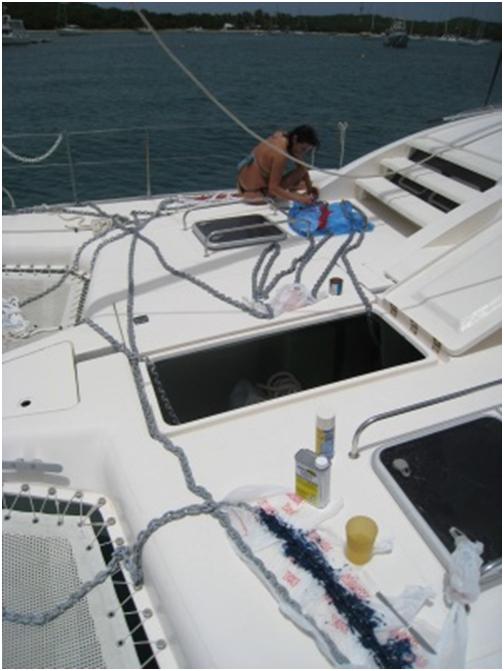 So that is exactly what we did for the brand new chain on our boat.
Here in the photos you can see how we laid the anchor all around our decks, put plastic bags beneath them, and painted them with an oil-based enamel intended for metal. However, since we couldn’t get a white enamel paint, we also used a spray paint intended for outboard engines. You can see that part draped over the lifeline to the left. It will be interesting to see which holds up better.
To make it really easy to identify depths, we used three colors: red, white and blue, which we used in sequence every 10 meters. Why 10 meters? Because it is also approximately 30 feet, so it makes it easy to use the markings whether the depth is measured in feet or meters, whereas if we did a mark every 25 feet, it would be hard to convert to meters, and also hard to interpolate for intermediary depths.
So, using these colors and markings, it is very easy to set the correct amount of rode. Suppose for example that we are in 17 feet of water. Multiplying that by 5 gives us 85 feet, which is almost 90 feet. So we let the anchor windlass run until we see the blue marker coming up. Similarly, if we are in 3 meters of water, that gives us a scope of 15 meters, which is half way between the red and white markers.
The other thing we did is to make the paint markers a couple of feet long. Again, this makes it much easier to see as the chain is zooming past.
One unexpected bonus of the white paint, at the 20 meter mark, is that it is really easy to see in the water, so you can see what direction the chain is lying in.
Wow! We made it!
Current Position: 18°21.28'N, 64°35.99'W
So, here we are, sitting by the pool in Tortola with a cold drink in hand!
The last week has been totally crazy. Went to Joshua’s graduation, which was lovely. He had a BIG grin on his face all day,.
Then we had to get him through airport check in with all his gear, including the wearing of 3 coats with pockets stuffed with books. Amazingly he a
made it.
And then we (Ceu, myself, and Jessica, Ceu’s daughter) had to get our stuff through the airport. We had 6 suitcases and boxes, all packed to the maximum 50 lbs, plus 3 carry on bags, also packed to the limit of 20lbs, plus two laptop bags, stuffed with socks etc, and a handbag, with a spare shoe in it.
And then, of course, I was wearing shorts under my long pants, my hiking boots, and a hat. But we made it through, and didn’t even have to pay any extra for the bags. And, because at Vancouver we cleared customs before we got on the plane, our bags were actually checked all the way through the Tortola, where they duly arrived with us, and with only one small hole in the box.
The flights were long and uncomfortable, and I didn’t get to see the end of Shutter Island, which is rather frustrating.
And then we arrived in the glorious sun and heat.
We dropped all the stuff at Conch Charters, had a quick lunch at Pusser’s Pub, and then hurried up the the Hummingbird House B&B for a swim and a nap.
Tomorrow we board Life Part 2 and set sail for a couple weeks gentle cruising around the BVI. The adventure begins…
Boat Insurance – To Get, or Not? That is the question.
Or at least it was the question at the start.
You see, many cruisers sail without any insurance. The main reason is that it is darned expensive. Typically 2-3% of the value of your boat. So on a $240,000 boat that works out at $5000. A year. Then you have to consider there is a high deductible, say $5,000, and the fact that, in reality, you probably wouldn’t actually make a claim unless the claim is substantial – or else next year’s premium will be even higher.
Putting that all together you then start to think about what you would actually claim for, and how likely that is to happen.The fact is, that huge claims, like losing your entire boat, are very rare. Whereas most of that premium is to cover damage or partial loses. But that $5000 could perhaps be better spent on upgrading equipment, or buying a radar or other safety equipment – a different kind of insurance, if you like.
After much thought I decided we would see if we could get just liability-only insurance. I can handle losing the boat. Sure, it would suck, but life would go on. But I figured it would definitely cast a pall over things if we ran over some kid in a canoe and had a million dollar judgment against us – though outside of the US that seems pretty rare. So we approached an insurer for that, and they quoted $912 for liability and collision coverage. That seemed more reasonable to me.
But, of course, there is always a catch.
Despite having years of dinghy experience, I haven’t sailed big boats very much. And Ceu has had only 3 weeks sailing in her life. So from the insurer’s perspective, we are a poor risk. But from the experience I have had in big boats, I feel very confident in handling them. And we will deliberately be sailing very conservatively so as to build up our seagoing experience before we do any long passages.
Nevertheless, the insurers don’t know that. So, after first saying they would insure us, They then said they wouldn’t, because Ceu didn’t have enough experience. Then they said they might, if they could get references from our instructors. But it seems that sailing schools won’t give out references for liability reason. So that won’t work.
So, at this point, it looks like we won’t have insurance after all.
Which was kind of what I was thinking in the first place! Oh well. Just have to keep a close lookout for little kids in canoes.
And stay away from the USA.
Well, just 11 days to go…
Sooo Busy
Well, we are back on track, but goodness it has been hectic trying to organize everything.
So here is the plan:
May 30th – travel to BVI along with Jessica (Ceu’s daughter) and six heavily packed boxes/suitcases full of all the stuff we have been gathering for the boat.
We will then do an “owner’s charter” of the boat for a couple of weeks – just cruising around the BVI, which should be a nice holiday.
Then on June 12th we will fly, via Panama and Lima, to Brazil, where we will spend two weeks touring around – visiting the Iguassu Falls, the Pantanal, Bonito, Rio, and of course Matteus and Renato, Ceu’s friends.
Then we go to Peru to do the Inca Trail and Macchu Pichu, taking in Lake Titicaca and a few nights in the Amazon jungle. Expensive, but should be awesome!
Then we return to BVI to finally take possession of Life Part 2 on July 19th.
From there it will then be a quick sail south to get out of the Hurricane zone before August. Especially since this year is expected to be a high hurricane year, with El Nino fading and sea temperatures fairly high.
Altogether we have a dozen flights booked to achieve all that. Not looking forward to that part, especially since a couple are night flights 🙁
Still, it will be worth it.
Aagh! Departure Date Delayed!
I can’t believe this!
Somehow there was a mix-up with Conch Charters and they have booked Life Part 2 out for Mid June to Mid July!
And we were just about to book our tickets to the BVI for May 31st. Just as well we didn’t 🙂
So, the plan now is to do some travelling first – maybe around BC, or maybe go to Brazil to see friends of Ceu’s, and then head for Life Part 2 on July 18th.
All a bit of a shock, but I guess it doesn’t really matter in the end. Just a bit frustrating, as we were all set to go.