

Famous Painter Releases New Masterpiece
 April 26th, 2012 |
  Author:
 Current Position: 40°13.77'N, 7°49.49'W
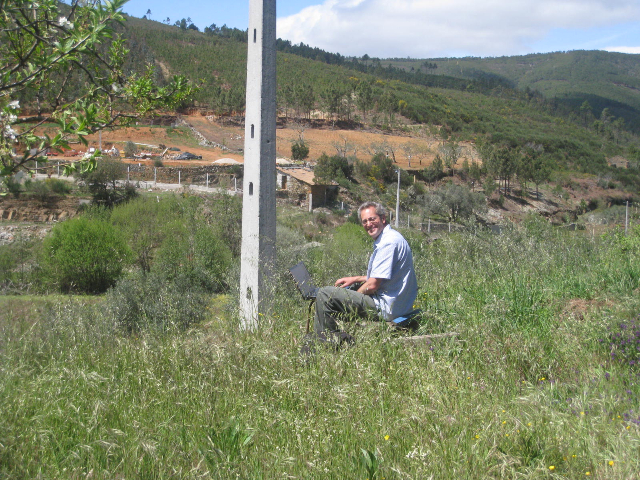
After almost 10 years of hiding, Noel Swanson has once again emerged into the forefront of the artistic world with the release of his latest oil on canvas entitled “Ceu and Raphael in Piódão” based on a recent visit to a very traditional village in central Portugal
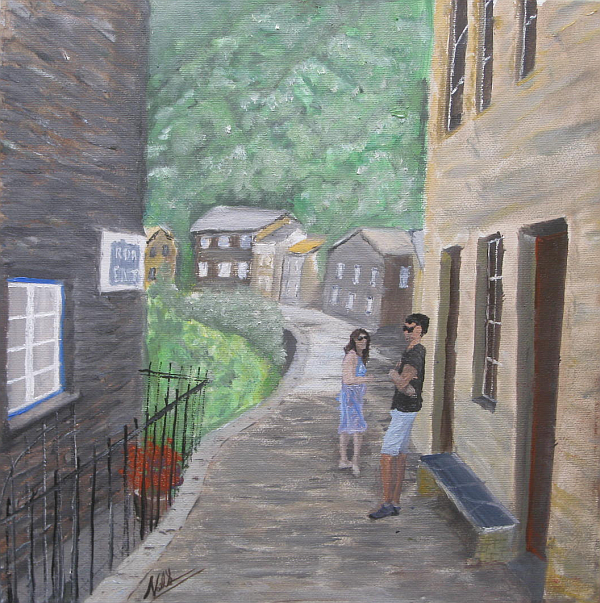
Back on Life Part 2 and a Visit to Portugal
Current Position: 40°2.36'N, 7°6.85'W
We had a wonderful winter in Canada full of fun with the family, Xmas festivities and great skiing!
We left Cartagena in November. Spent one week in England with Noel’s family where we celebrated Elmer’s 80th Birthday, his sister’s Birthday and also mine. It was a wonderful busy week.
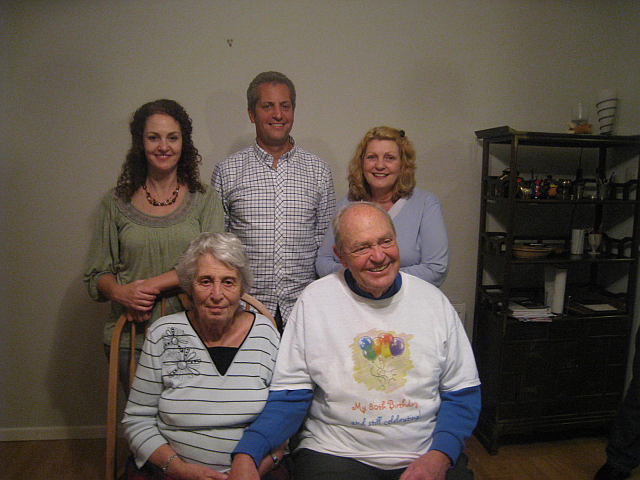
Elmer's 80th Birthday!
We the flew into Panama for 10 days, arriving in Kelowna before Christmas. Ahhh, but before Xmas we celebrated my grandson Tiago’s 2nd Bday. Talk about culture shock….after traveling through the Caribbean and others, and seeing how people live happily with so much less , I was really surprised at how it shocked me coming home to big Bday parties and gifts, and all the hustle and bustle of the Xmas shopping and all of the extravagance and stress that goes with it. It sure takes away the spirit of Christmas as well. All I could think about was spending time with my family. I had a wonderful time with my kids. In February we welcomed my second grandson Jonah into the world. He was a handsome and big boy at 8lbs 6oz . I sure miss them a lot.
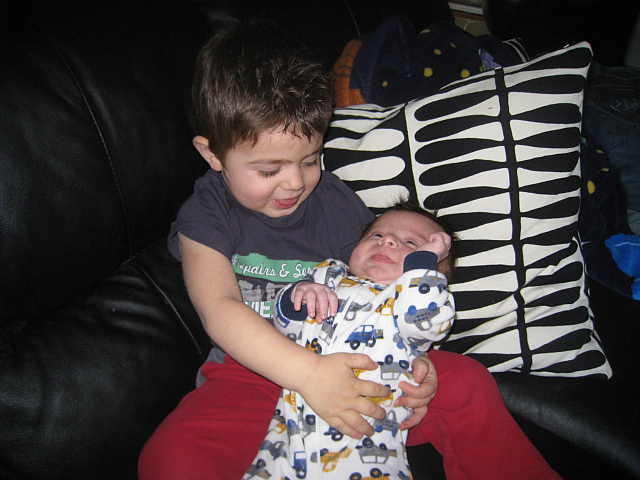
Tiago and Jonah

A New Grandson!
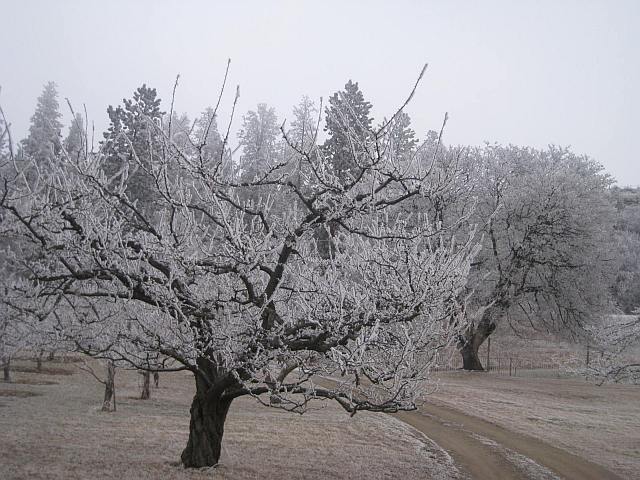
Winter in Kelowna outside our temporary home
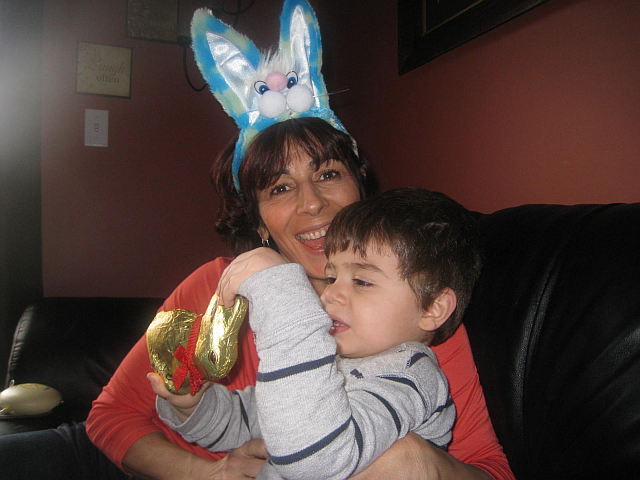
Early Easter in Kelowna
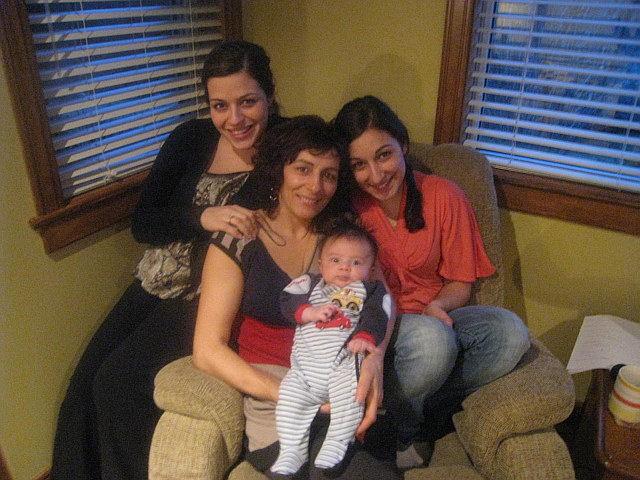
My Honeydews and Lovey 2
We left Kelowna in early April 2012 on the way to Spain to get back to Life Part2. We made a stop in England to visit Noel’s family where we celebrated Heidi’s 83th Bday and a roast of lamb dinner to celebrate Easter. We had a nice week there with the family. Food, fun games, nice walks in the beach at Lee on the Solent where it’s always fun to see all the kite and board surfers.
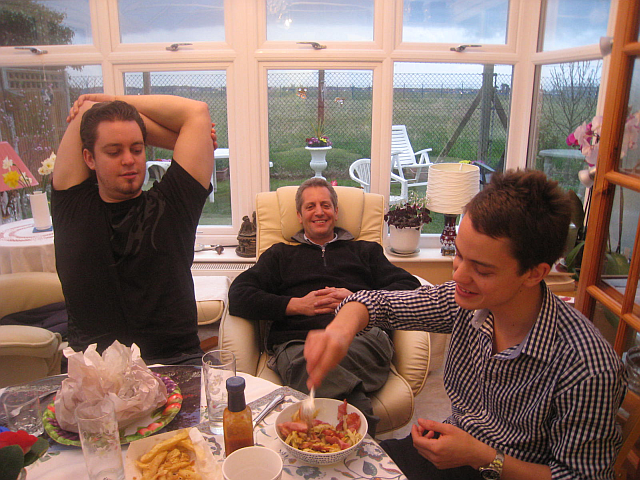
Fish and Chips in England
We flew into Cartagena on April 7th.It was nice to see that our floating home was still floating and doing well. It looked great,except for all the dust outside…It was clean and neat. It doesn’t look like that often when we’re around! I can see Noel already laughing at this, that’s because I often tell him that the house is looking like a workshop again! He is always fixing things or or home improvements of some sort. There is no end to cleaning and maintenance on a boat. At this moment it’s a beautiful sunny day we are at anchor in the smooth waters in Mar Menor. I get to write this siting outside on the cockpit and trying not to get too distracted with some beautiful live music coming across from a beach bar. It makes me wanna dance!!!!!!
We had big plans to finish our rigging upon arriving in Cartagena. One trip up the mast and Noel realized: wrong size! We had them shipped from US. They made a mistake. It meant we had to wait another week for delivery here. Decided to rent a car and drive to Portugal and see my side of the family.
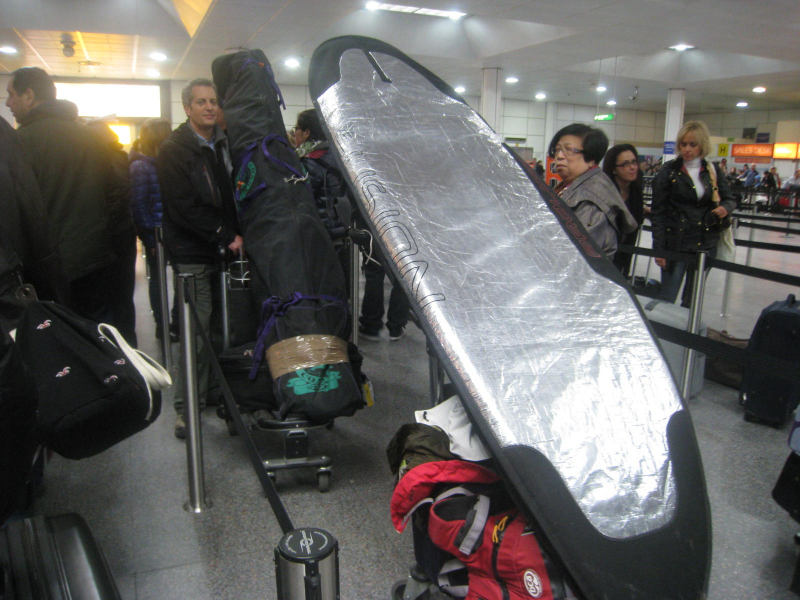
Noel’s idea to rent a car (wonder why) not cheaper, in the contrary. But we were so tired of waiting at airports and their stupid securities with all the stuffed cases we bring with us, did you see the picture?What we look like running through airports with buggies so full, taller than me, can’t see where I’m going till someone is rushing to help by loading up the stuff that’s sliding over and everyone is looking at you. It was a lot of gear to carry from England because Noel bought a windsurfer there. So it added more fun at the airport but everything got here fine. Noel is excited to try it. Yesterday we set it all up but not enough wind to do it.
We drove close to 1000kms to my hometown. You see….Noel decided to apply for a driver’s license in England. It meant he had to send in his Canadian one. His driver’s license just arrived. So he had a chauffeur, that’s why the idea of the car rental…smart! The drive went well, and the scenery varied a lot. For most part was dry, flat, not so attractive, but many cultivated fields. I enjoyed looking at the crops of potatoes, tomatoes, peppers, cauliflower, broccoli and many artichokes which I had to stop and check it out. I had never seen artichokes growing. Cartagena has very nice weather all year around so they can actually grow 2 crops a year and it was neat to see how some of the potatoes were ready to be dug up and some were just starting to bloom. Also along the way were many grapes, and also orange and olive groves. As we got closer to Portugal scenery was more green and a lot of blooms, along with the famous cork trees as well.
Great highways, 120kms throughout. I went a bit more. Testing out the car! I told Noel that car was not powerful enough for this long trip… it was kinda shaky! As soon as I said it, a Spanish sign read to “slow down, caution, very windy zone” and dozens of wind mills! Well I think my car was doing fine, just my foot was a bit heavy.
We had a good time visiting family in Portugal. It was a very unusually late Spring. We were lucky to still have some sunny days and my Mom was glad that I was able to help her with her big garden. We seeded lots of potatoes, beans, planted lettuce and cabbage and more. Best of all I got to spend quality time while doing it. She was happy to share old stories with me of the times we spent together, working side by side, day after day through sunrises and sunsets. We shared some great memories and as usual I loved listening to her telling me about childhood and what it was like for her, to raise 8 kids. She is an amazing woman!!!

Someone losing at cards?

Guess who's winning now?
Noel and I enjoyed our usual hikes there. Last summer we always finished with a fresh water swim in the river, but this time…too cold! But the mountains were covered in scented blooms and heather, so there was a beautiful fragrance in the air. We did another hike with a group along the Rio Zezeres to some old tungsten mines.
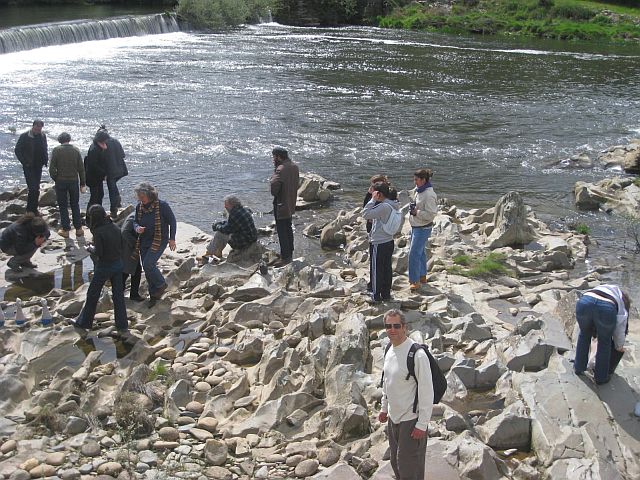
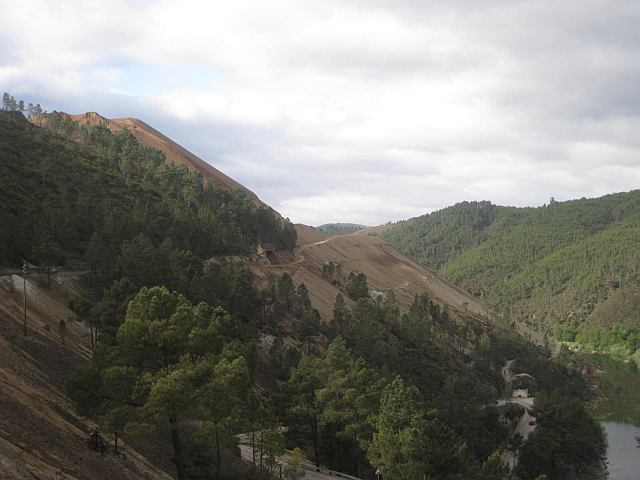
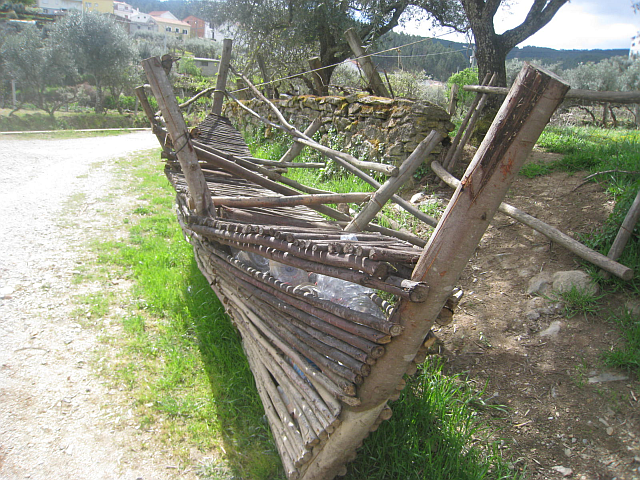
During our hike, we even found our next boat!
The mines were pretty dilapidated although across on the other side the mines are apparently still operational. It was a pleasant walk along a nice kayaking river. Hardly strenuous, but it got us out and was ended with a nice stewed goat meal.
We also did some sight seeing. This time we visited Monsanto, in 1938 it was voted in a national contest as the“most Portuguese village of Portugal” (no idea why it is called that) Very interesting and historical place. The town is built up in the hill slope, it abruptly rises up to 758 meters, highest point. Most houses are built right into these massive granite boulders along the sides of very narrow streets and steeps steps.
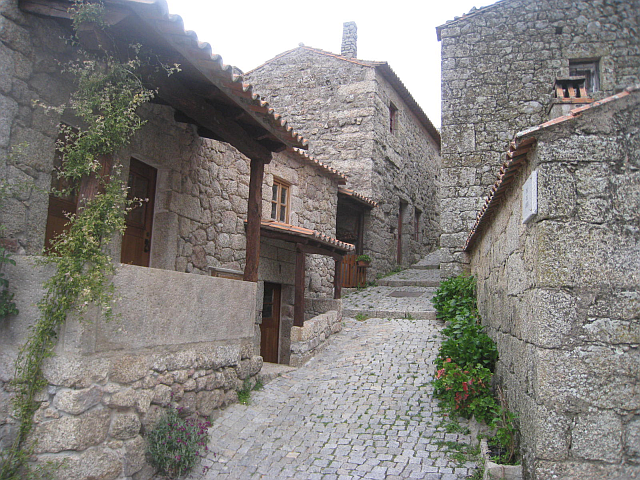
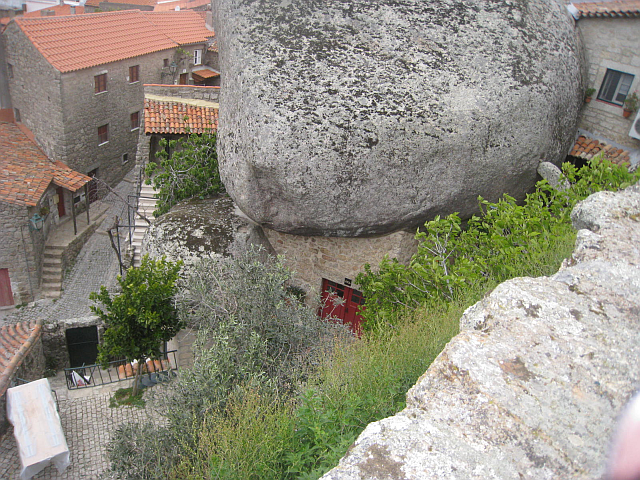
That's a house under that rock!
Amazingly the inhabitants are mostly elderly who must keep in pretty good shape by walking up and down to get to their homes. They are very friendly and come out and mingle with the visitors and proudly start talking about their town and it’s history and how building restrictions has allowed it to remain as a living Museum.
Also the village of Belmonte with it’s Castle from the 1300, where Pedro Alvares Cabral was born. He discovered Brasil in April 1500. Lots of museums and history on Brazil and Portugal.
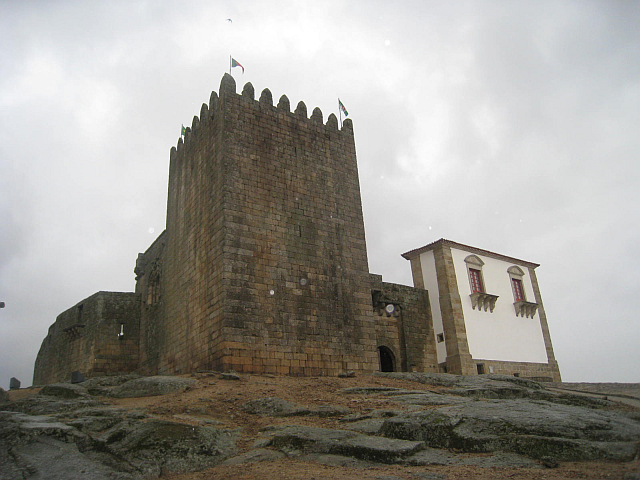
Pedro's birthplace

Pedro Alvares Cabral - discoverer of Brazil (ignoring, of course, those who already lived there who didn't realize they hadn't been discovered yet)
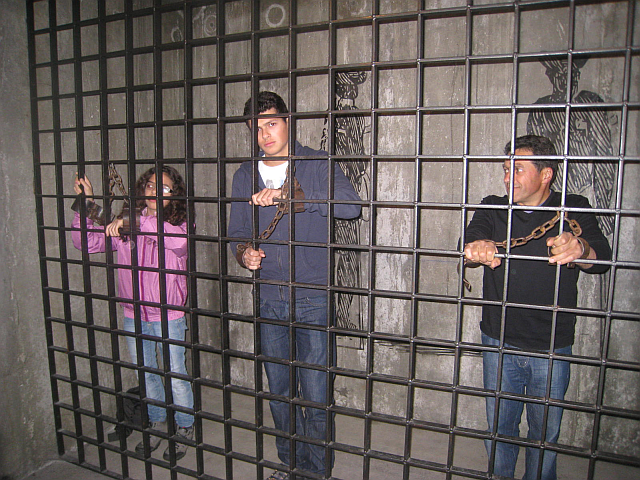
Ooops, what have Sara, Raphael and Carlos been up to????
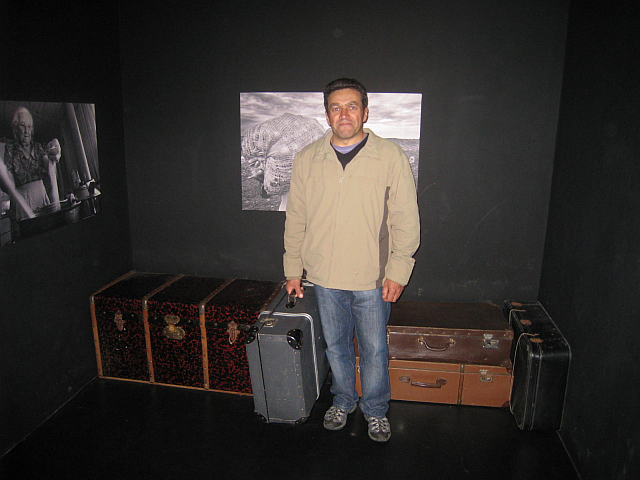
Maybe he stole the suitcase from the museum?
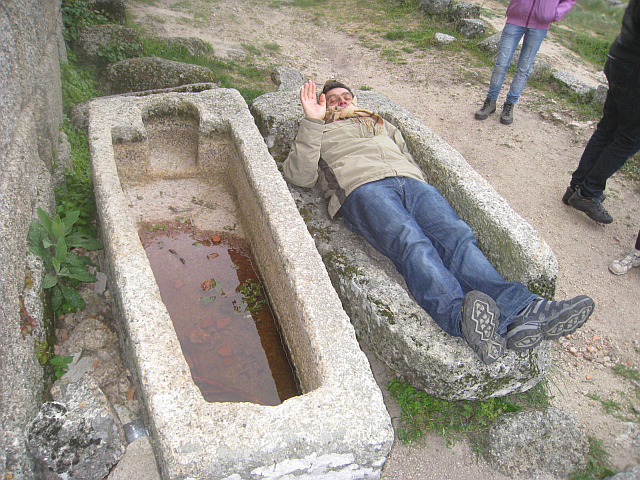
Trouble is, the coffin is too small for him. Maybe the next one beside will work.
On the drive back from Portugal we had a lot of traffic, it was a Friday and we thought probably was a long weekend in Spain. Noel, my navigator, took a nice nap but decided to wake up just in time to tell me to turn right “here, now”. I just about missed our turn. Secretly, I really wanted him to wake up in Madrid!!! lol I had seen a sign just before that saying Madrid was only 30 or 40kms straight ahead. Too bad he woke up so soon…it would have been a great detour! Wouldn’t mind visiting Madrid.
We were in a hurry and excited that our shrouds were supposed to arrive that day. We could finish our rigging and get sailing! Sure enough…we arrive in the evening, turn on the computer and email telling us our parcel is at customs, requesting a copy of Noel’s passport before releasing it. Noel did that immediately at the Marina office but of course, IT WAS long weekend! A extra long weekend, a Spanish one, not 3, but 4 days long. Well we could have stayed in Portugal longer OR at least send my honey back to sleep and wake him in Madrid!!!!
Back On Board and Raring to Go!
After a 5 month break, visiting Panama, Canada, and the UK, we are now back on board Life Part 2 in Cartagena, Spain.
Everyone told us that is was the warmest sunniest winter for years but, of course, as soon as we get here it starts to rain. No matter, we still had a bunch of stuff to get done.
First was to service the engines. This time Ceu did the job! Yes, there she was, pumping the old oil out through the dip-stick. Then a quick change of the filter, pour in the new oil, and she was good to go, with nary a spill of oil. Good job done.
Then we tried to hoist the genoa up the new forestay. Oops. Sito had installed the channel pieces backwards, so the grooves for the genoa luff didn’t match up. So that was an additional few hours of work for him.
However, in the process, his English-speaking friend Sem came around, and then drove us around town to some of the key shops, which was very helpful. He is also organizing a new engine battery for the port side, as that seems to have died. Today he drove us around town so that we could get our bicycles fixed (well, one of them, anyway, the other is not worth salvaging), buy a couple of new paddles for our kayak, and a ladder out of which to make a passarelle. It makes a huge difference having someone who knows where to find stuff in town, and can take you there.
And finally we are putting up the new standing rigging, having lugged it all the way from Canada.
Apart from that, all is well with Life Part 2 – she seems to have wintered well with no problems.
Ah, yes. The joys of traveling through airlines with BAGS and WINDSURFERS. Well, we did it. With careful calculations of allowable weight we got everything here, including a brand new windsurfer and three sails. Can’t wait to get that rigged up and on the water! Actually, it turns out that we had no difficulties at all with either the flight from Canada to UK or with EasyJet from Gatwick to Murcia. And then at Murcia we found a large taxi that took us straight to the marina. Couldn’t have been easier. The trick with EasyJet is that there is no weight restriction on hand carried cabin luggage. As long as it is small enough to fit in the racks, and you can carry it, you can take it on board. So we put all our books and stainless steel in the back pack for a total weight of 30lbs! You can see it on the trolley below.
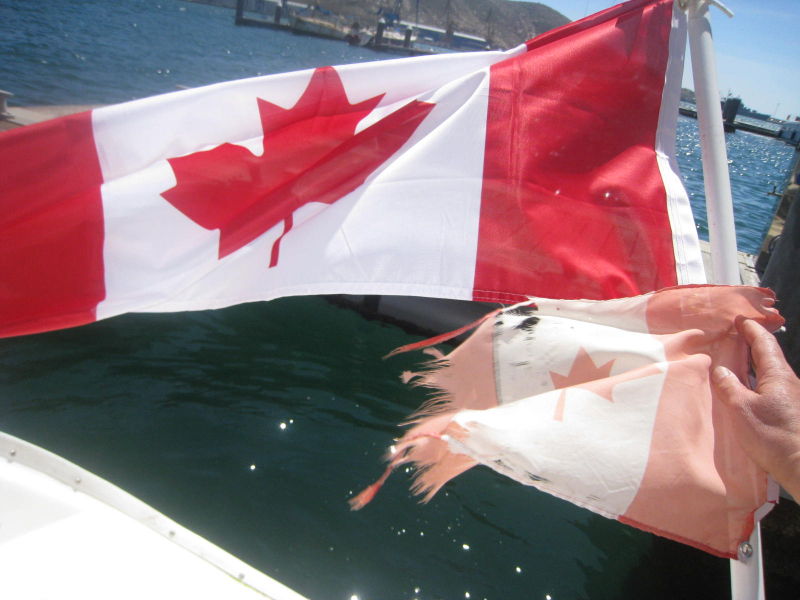
Oh, and almost forgot – a brand new Canadian flag to replace a rather beaten up old one!
’tis good to be back on board 🙂
This Is Why You Replace Your Rigging Every 8 – 10 years.
Current Position: 37°35.78'N, 0°58.79'W
Distance sailed since last post: 112 nautical miles
Stainless steel rigging is subject to crevice corrosion. The problem with that is that you cannot see it until it actually breaks. Then it is often too late.
For that reason it is recommended that the rigging be routinely replaced every 8 – 10 years.
Ours is at that 10 year mark, so we are in the process of replacing it. And just as well too! Look what we found when we took down the old shrouds:
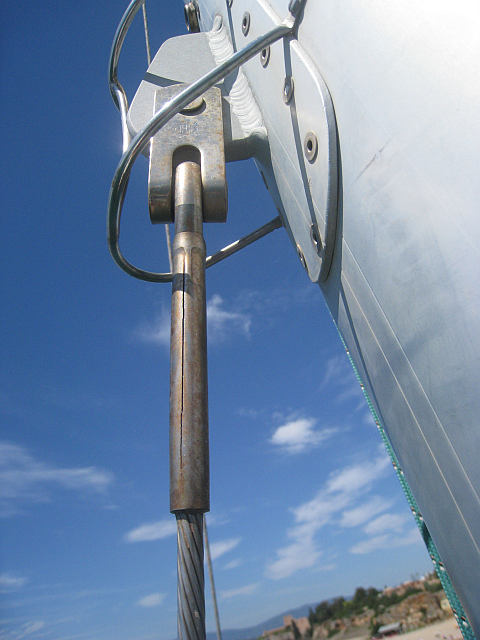
See that nice crack in the swaging? When we actually took the shroud down, we could see that already the wire cable had pulled out about 3mm. Just as well that as soon as we saw that we doubled up and used the spinnaker halyard as a second shroud – and we also avoided sailing on starboard tack.
We have now replaced it with some nice new Dynex Dux rope rigging.

But that wasn’t all…
Today we took down the forestay and jib furler in order to get the wire inside that replaced.
And look what we found at the top of that:
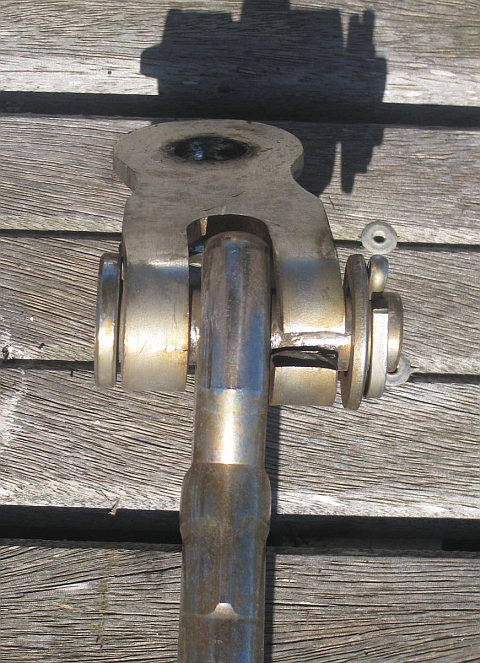
As you can see, the bracket holding up the forestay is completely broken on one side, and already cracking on the other! Another very close call. I think a few more sails in some strong winds and that would have given up the ghosts.
So, I am glad that we had the replacement schedule in place. Remember, at the time we started to plan for doing the replacements, neither of these cracks were visible.
In fact, that is one of the reasons I am switching to the Dynex rigging: at least all the damage to that occurs on the outside, where you can see it, rather than on the inside where you can’t until it is (probably) too late.
Impressions of La Linea and Gibraltar and Onward to Almerimar
Current Position: 36°41.74'N, 2°47.51'W
Distance sailed since last post: 128 nautical miles
After crossing the Gibraltar strait, it was very impressive arriving in the large Algeciras Bay at dusk. I was surpised by how many huge tankers there were sitting at anchor in the bay. They were all lit up like Christmas trees, making it very pretty. Apparently the bay is officially international waters, so they can anchor free for a month without hassle as they wait for their next shipping job. And of course there was the Rock, towering over everything.
It was at this point that we discovered that our chart plotter charts didn’t cover the area! I had planned to buy new charts for the Med when we got over here, but a) had forgotten and b) in any case, no one seems to stock them. All it gave us was the barest of shore outlines.
However, we did have our back-up charts on the laptop, using the free OpenCPN chart plotting software (which is excellent). This is what we used for our trip all the way to Cartagena, as we couldn’t buy any charts in Gibraltar either.
We managed to find our way in to La Linea, Spain which is right next to Gib. We anchored, in the dark, inside the harbor, but outside the marina, despite warnings that the police might move us along.
As it happened, they didn’t, and we had a pleasant stay there, along with a handful of other boats, for a couple of days.
On the Monday we then moved over the Queesnway Quay marina in Gibraltar. There I picked up my new shrouds without any difficulties. It was a straight forward process of going to the FedEx office, where I picked up some papers and took them across the road to the Customs office at the Airport. There I presented the boat papers and my passport. They filled in a form, and that was that; no duty or tax to pay.
We then went back to the anchorage at La Linea where I spent a couple of days getting the new shrouds installed.
Meanwhile we did, of course, do some sightseeing in both Gib and La Linea.
In Gib we took a bus tour to the tunnels, saw the monkeys (who sat on my head), visited the Pillar of Hercules monument, and wandered through the botanical garden.
The 32 miles of tunnels dug into the Rock are very impressive. Certainly you don’t get a better fortress than one made of solid mountain!
Unfortunately I managed to delete all the nice photos by accident. A real shame as there were some fun ones of the monkeys sitting on my head.
It was a good half day visit.The trip to Morrisons supermarket also allowed us to buy some English mustard and mint sauce.
Beyond that, Gib is not recommended. Very busy with traffic. Not a pretty town. Not a lot to recommend it really.
La Linea is the same. It is clearly a very poor town, with lots of run-down housing. The small historical downtown is quite nice, with cafes on the streets, but that is about it.
We had to pay5 euros a day if we wanted to leave our dinghy somewhere safe when we went ashore, otherwise it was likely to be nicked. You can walk from La Linea, through customs, across the airport runway, and into Gibraltar. There is also a bus (number 5) available at the airport that will take you into town and right to Morrisons.
Anyway, we got the jobs done, and we then had a great sail on a broad reach in 25kts to Fuengirola, where we met up with Mark Thompson and had a lovely carvery roast lunch. All very English on the Costa del Sol!
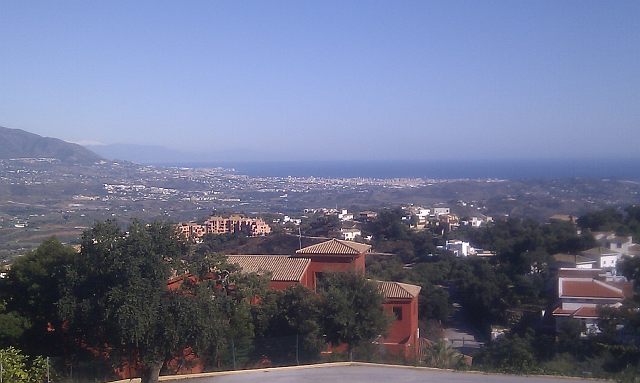
This was the view from the restaurant:
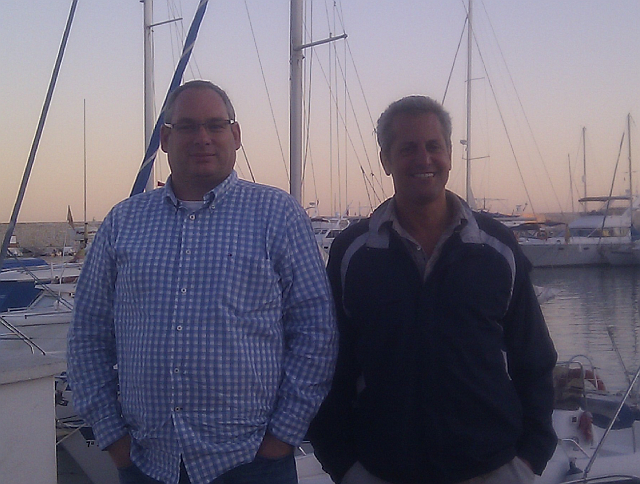
And here is my internet marketing buddy, Mark Thompson. That is the cool thing about internet marketing – you get to meet people all over the world. We have talked many a time on Skype over the past 4 years, but this was the first time that we actually met in person:
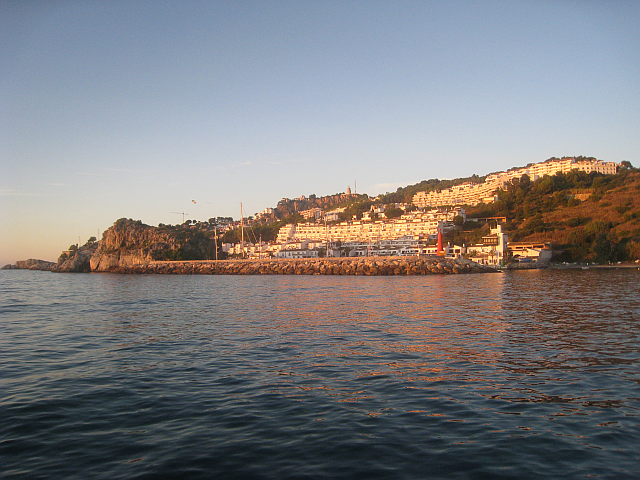
 The next day was another fresh sail past Nerja (where I could see the apartment I used to own) to the little bay at Herradura. There is a small marina there (Marina del Este) but we anchored just outside it, and then went ashore for a lovely pasta meal.
From there we had yet another fast sail,
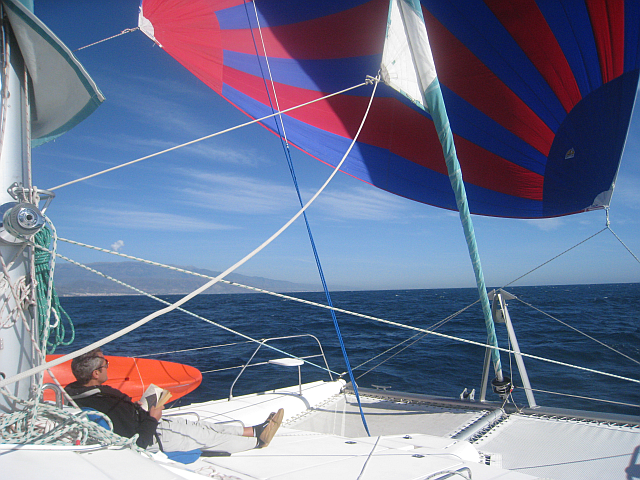
past acres and acres of plastic sheeting (for growing tomatoes and other crops) backed by the snowy Sierra Nevada,
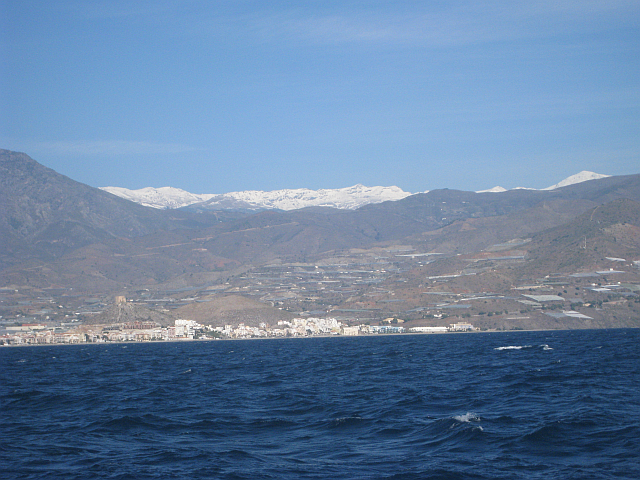
To arrive in good time at Almerimar. Almerimar is easy to get into. The fuel and reception dock are just on the left, immediately after you arrive.
Then you get allocated a berth, which is all med moor with bow lines that are tied up to the dock and you then have to walk them forward to tie up the bow. We were parked in that big space, just next to the other cats:
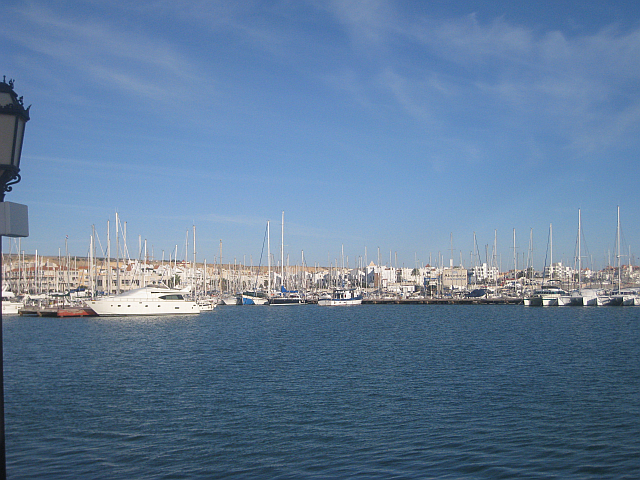 We then walked around the docks to find Bob and Connie from Meridith (fellow Canadians we met in Portimao).
They had a car. So the next day we went to visit one of the Pueblo Blancos (White Towns) – that’s Bob in the photo:
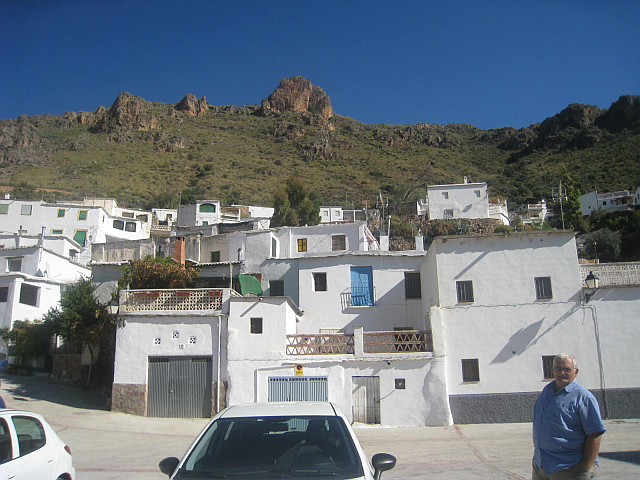
where me met a crazy German who had retired to this tiny village of 15 inhabitants. He proudly showed us around all the upgrades he had been doing to his house, including a lovely patio:
 On the way back we picked some prickly pears – and managed to get lots of prickles in our fingers. It wasn’t worth it – they don’t taste of much!
Next day we were on the move again.
We rounded Cabo de Gata, and now were in the Costa Blanca (so named because of the limestone cliffs – though most of them were still the same rock as the Costa del Sol). We had a brief overnight anchorage at Carboneras, tucked in behind the northernmost harbor wall.
The next day we pressed on to Cartagena. This time we had to motor, but a headwind was forecast, so we wanted to get moving. We arrived without fuss just as the sun was setting.
 Posted in Destinations |
  Tags: Almerimar, Costa del Sol, Fuengirola, Gibraltar, Herradura, La Linea, Spain |
  1 Comment »
New Shrouds Up and On Our Way!
We finally got our new Dynex Dux shrouds and put them up (with a little bit of hassle because of the length, but more on that in another post).
Good thing too – when I got the old shroud down I could see that it had already pulled out about a 3 millimeters. Imagine if I hadn’t spotted the crack and we kept sailing! Kaboom! We could well have had a dramatic mast overboard situation. To see what that would look like, take a look at the videos on this page: Mast Overboard and other sailing disasters. They are very interesting and very instructive!
So, after another wet and windy storm, today it is sunny, the wind and tide are right, the shrouds are up, and we are on our way. We now start to work our way East, aiming for Cartenega where we will leave Life Part 2 for the winter.
First stop today is Fuengirola, just past Marbella, where we shall hopefully meet up with internet marketing buddy, Mark Thompson.
Sailing The Gibraltar Strait from West To East
Current Position: 36°9.45'N, 5°21.92'W
Distance sailed since last post: 84 nautical miles
We had it all figured out. A neighbor in the marina lent us Colin Thomas’s guide to sailing the straits (yes, the same Colin from Summer Breeze that we sailed with two years ago), so we had all the gen on the tides, which are very complicated. This book is the definitive work, and is pretty much essential if you want to get these 3 knot tides figured out. You really don’t want to be trying to sail AGAINST a current like that!
The forecast was for Force 5 Northerlies, decreasing through the day to end at about a Force 2 or 3 Westerly in the Strait.
High tide at Gibraltar was about 4:45pm. We wanted to be off Tarifa at High Water so as to catch the strongest tides across to Gibraltar.
I figured out that if we left Cadiz at 6am, then we would make a good 5 knots in that wind (with engines to help if needed), and so we would be at Cabo Trafalgar (Where Nelson did his stuff) at about HW minus 5 hours, giving us 5 hours to complete that final 25 miles to Tarifa. At Trafalgar we would still have some current against us, but it would be turning over the next couple of hours.
So we went to bed in a howling gale (or at least it sounded like it) and hoped that the storm would have settled in the morning.
At 5:30 we got up, picked up the forecast (still the same) and decided to go.
Leaving the harbor was a bit bumpy with big waves and 18 knots of wind against, but as soon as we turned south it all disappeared. Soon we were motoring in a flat calm, doing barely 2 kts against the tide. Meanwhile, the weather updates on the radio were still talking about the Force 5. How can these forecasts be so wrong??????
We arrived at Trafalgar 3 hours behind schedule. Gradually the tide turned, and our speed (but not the wind) improved. We arrived at Tarifa about 2 hours behind schedule. But now the tide was strongly with us. Soon we were moving at 9kts, with the wind picking up too. The sun was shining, visibility was good, and the sea was smooth. There was constant chatter on the radio with all the ships going by and checking in with Tarifa radio.
Some poor soul was getting heck from a Spanish warship who said he was in a military practice area, even though the other ship’s chart said he was outside it.
Then, on top of everything, our autohelm decided it didn’t want to work any more. So now we had to hand steer for half of the journey. Well, at least we didn’t have to do that for half of the Atlantic!
We arrived at Gibraltar just as the sun was setting. Spectacular! So many ships at anchor in the bay, so many lights on the ships and on the shore. Could have been Christmas.
Now all we had to do was find our way to La Linea (the Spanish town that borders Gibraltar) even though our chart plotter didn’t have a detailed chart for the area. It seems our charts only go as far as Tarifa! Fortunately we had a backup chart on the laptop.
We pulled into La Linea harbor in the dark, found a nice spot to anchor just next to another catamaran, poured ourselves a rum punch, and sat down to write this.
A full and interesting day! We look forward to exploring ashore tomorrow.
Guadalquivir River to Bonanza
Current Position: 36°48.47'N, 6°20.62'W
Distance sailed since last post: 36 nautical miles
We just left Sevilla 2 days ago. We had a great trip back down the River again. First day made it to about half way, and the next morning we weighed anchor and set off at flood time. It was a lot more traffic around this time, ships, motor boats, maybe because it was weekend?? Even a couple of guys crossing the River on their paddle, surf boards carrying goods: boxes and a big tin.
We were sure coming down fast with such strong current, till the wind picks up to 20 kts against us, about then, tide was turning too. Timing was good at least….we were just about arriving at our planed stop for the night at Bonanza. It was a beautiful sunset and we anchored just before dark. That was last night.
That was the night, we had our first winter storm. And no! Noel is not going to write about it, because the title would be THE STORM…and my kids at home get very worried! (I just prefer not give it away in the title, prefer a smoother approach!) Noel would also tell you though, it was fun. About midnight the winds had picked up and lots of rain too. The river was not smooth either, there were big waves and noisy anchor chain with all the current rushing by. This morning was dark till almost 9am. Although we enjoyed our lazy morning in bed, we got up and checked the wind, it was up to 39kts. Still raining too, but it didn’t stop Noel from walking in the rain all around the boat and enjoying it. We had not seen rain for months and temperatures have always been 30 and over, up until Sevilla.
After lunch the rain had stopped and the sun was out. We crossed the River into the town of Bonanza in search of internet, or most importantly to recharge our data Vodafone stick. After many stops, which they all seemed to be Movistar, Noel practices little but real Spanish, and I practice lots of my Portinhol. Sometimes they understand me, sometimes they don’t. But that’s only because they’re not speaking the right Spanish which I was just speaking in the last city, the language seems to change as we move along! Seriously, today I asked for matches “fosforos” at the store, she didn’t understand me, I even confirmed on my dictionary before I went out. She called them something else. And sure enough it’s even written fosforos in the box!
Still hunting along for internet. They all tell us to go ‘recto’ ‘deretcho’ (straight on) …we finally get to a Vodafone place. Only to find the doors closed! They had just closed for lunch. But not just for lunch. They close at 1,30 and reopen at 6pm. That’s a nice long siesta!
We bought the stick in Sevilla, paid 30 euros . They told us it was good for 3 months, or 1gb. Thanks to the beautiful work Noel does here with the blogging…..it also lasted only 2days, and we are still now searching for a place to recharge our stick. After not having success with that, all we wanted to check was the weather as we plan to leave tomorrow am.
Finally we found an internet café. Great! Not so great. We were not allowed to plug in our laptop. Noel has all his grib files on there.
We kept walking and Noel turned on cell phone and checking for some wifi in the area. Sure enough, we had some connection. But don’t bother looking for any comfy seat or a park bench. As you walk there, or even few feet forward, or backwards, you lose it and there goes the weather! Just sit down now, right here in the side walk. It was quite funny! It worked well. Did some grocery shopping and came home.
We are now checking tides for when to leave in the morning. We have a short trip to Cadiz. But Noel is busy also getting lots of info about sailing the tricky Gibraltar straits, that’s where we are going in a few days.
Looking forward to visiting Cadiz.
Will get back to you when we find a Vodafone store. If you can read this, congratulations to us! Only then, this blog post will be uploaded.
Update: just arrived at the marina in Cadiz.
Impressions of Seville
Current Position: 37°20.65'N, 6°1.36'W
Distance sailed since last post: 19 nautical miles
In 1492 Columbus sailed the ocean blue.
In 2011 we sailed the ocean blue. When we set off we had 3 GPS’s, detailed charts, daily weather forecasts, plus historical data on the best times of year to travel, and the best routes to take. And then we had radios, liferafts, EPIRB, and watermaker as backups.
He, along with two other ships, departed from Seville to sail around the world in order to find a route to India that avoided the Cape of Good Hope. He knew the world was round (though many doubted him), but he had no idea how big it was. Well, maybe he had some clue, based on how far around the world he figured they were when they went to the orient.
Whatever the case may be, he set off with no charts, no weather forecasts, no idea of trade winds and current patterns, and no idea how long the voyage would take, and thus how much food and water to take.
Think about that for a moment.
Puts it all into perspective. Even after the trade routes were established, as many as one in five ships never made it across the pond.
It was, of course, that epic journey that basically made Spain, and Seville especially. From that day, for the next 200 years, they OWNED the new world, and all the trade that came through it. Which included heaps of gold and silver that passed through the Torre del Oro on the banks of the Rio Gaudalquivir:

The result is a fascinating historical city. Everywhere you turn there is evidence of the heydays of the 15th to 18th centuries. Huge baroque palaces and countless churches, including the word’s largest cathedral:
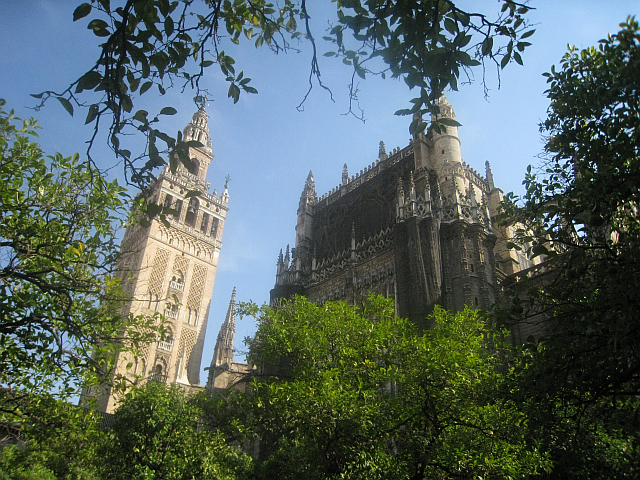
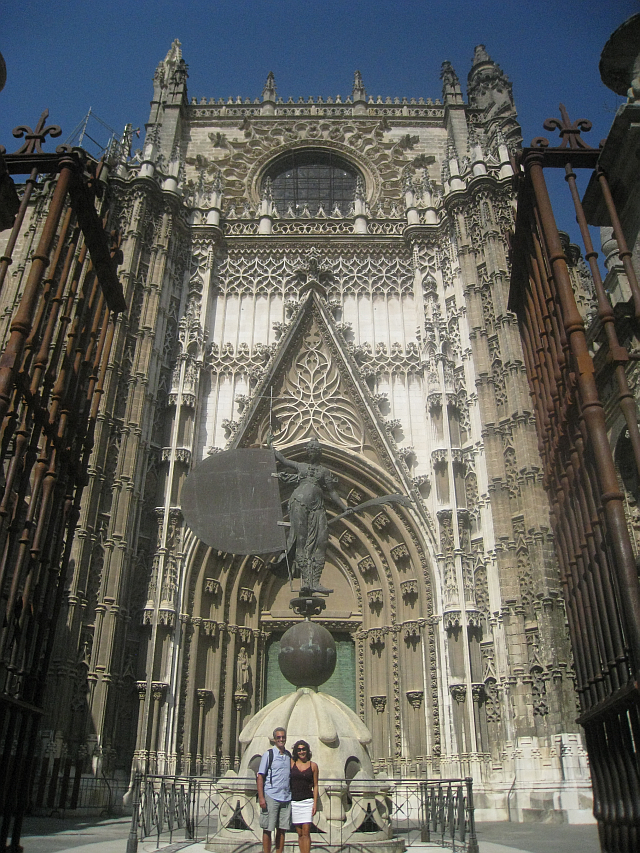
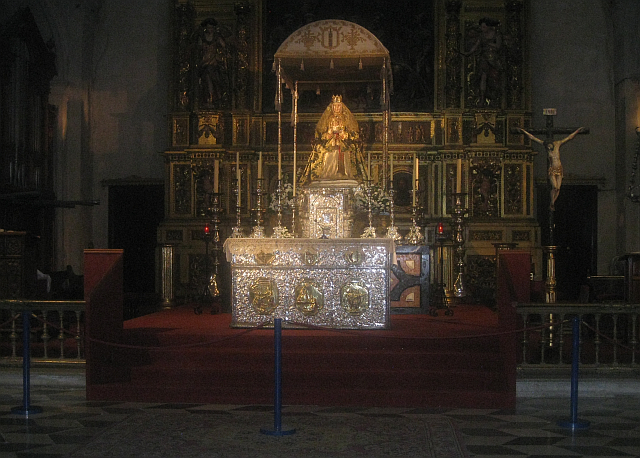
Inside these they are just filled with heaps of gold and art, all in the elaborate baroque style.

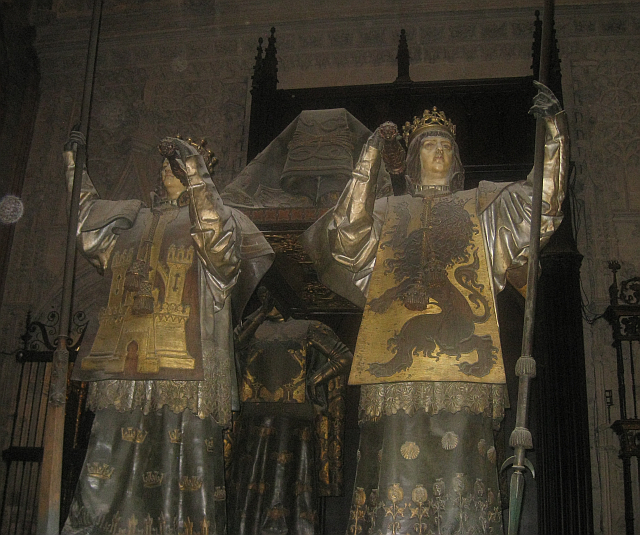
Plus, of course, the tombs of famous people, like Christopher Columbus himself.
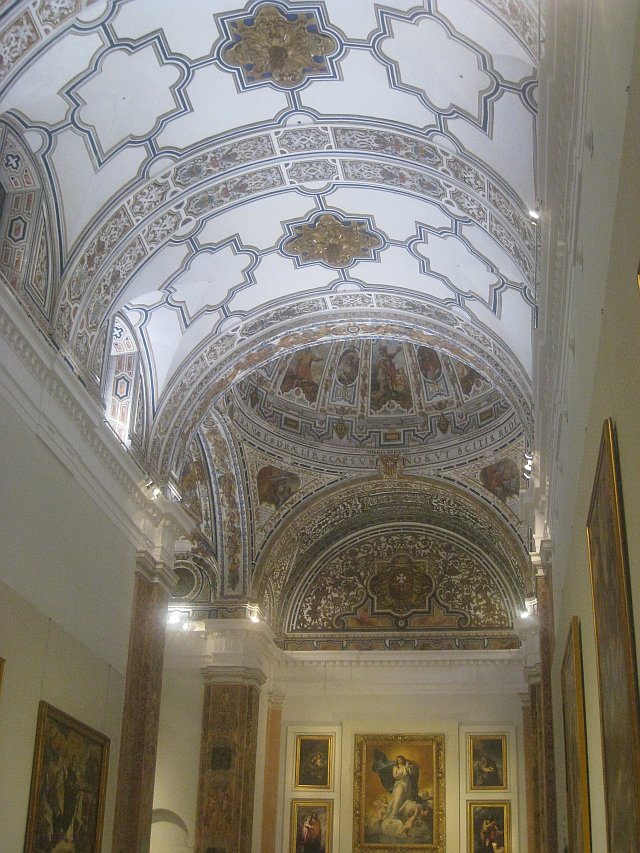
Even the art museum is a work of art in itself:
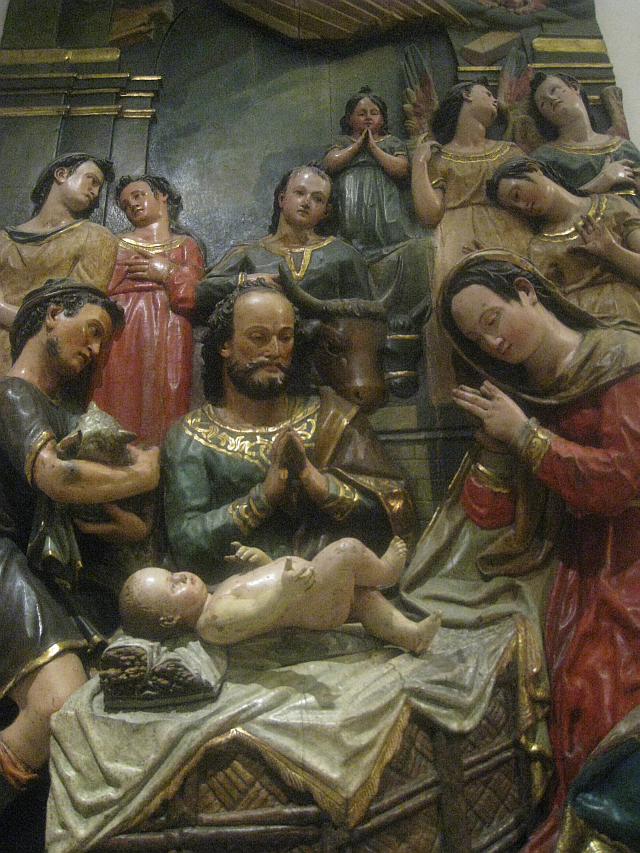
As well as paintings, there is also bas-relief (sort of a half-way house between a painting and a sculpture):
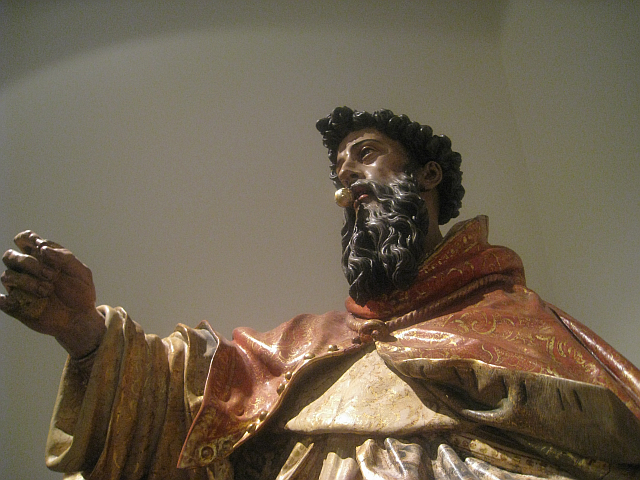
And even some guy with a lip-ring that seems to actually join his lips together. Some of today’s punks could learn a trick or two from him, I reckon:
Underneath all the baroque and catholic stuff is, of course, the legacy of the muslim Moors who lived here until they were kicked out by San Fernando. This is said saintly king:
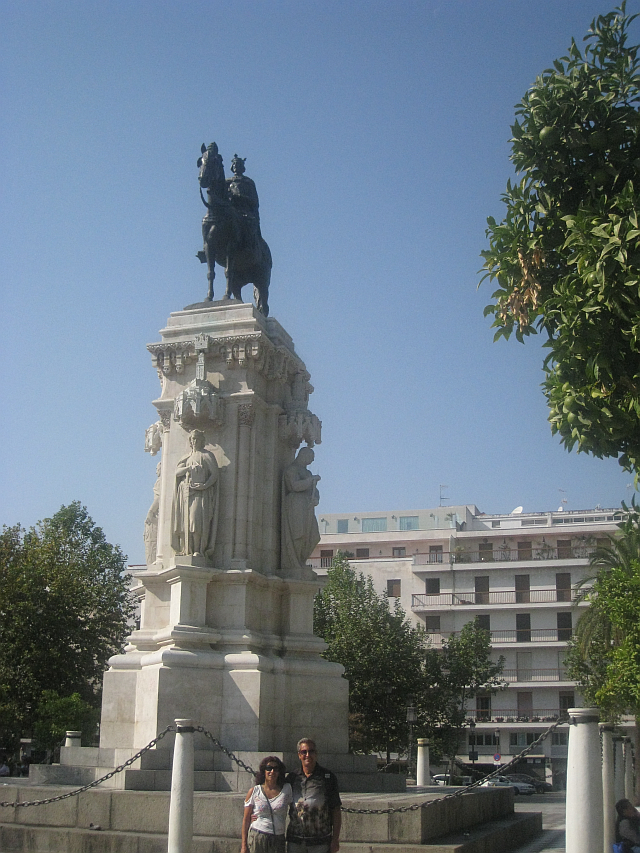
(plus a very handsome couple of tourists).
Right next to the Cathedral are the three royal palaces. These range in style from original Moorish, to “in the style of the moors”, to Baroque.
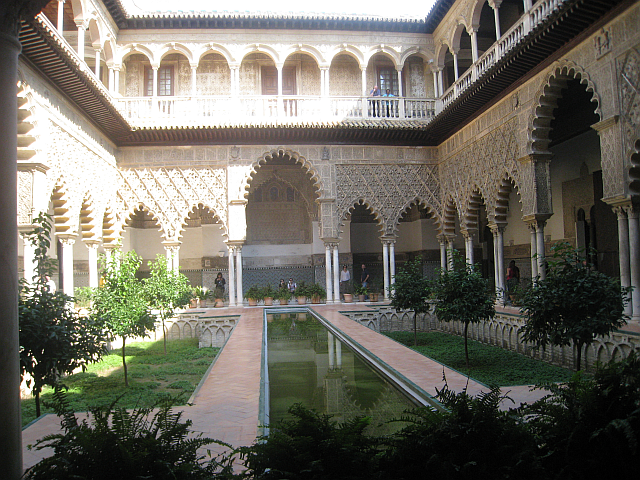
It seems that one of the kings preferred the Moorish style of decoration to the Christian, so he had his palace built accordingly. This was during the time when the moors were still allowed to live in the city, before they were finally expelled at the beginning of the Inquisition.
Inside the palace gardens is a musical organ that plays music once an hour, operated entirely mechanically b

And also a ‘drunken tree’. You can just see that the lower part of the trunk bulges out. When it rains, that bulge gets bigger – as much as 2 or 3 times the diameter of the normal trunk – like a beer belly (hence the name) or, more accurately, like a camel’s hump.
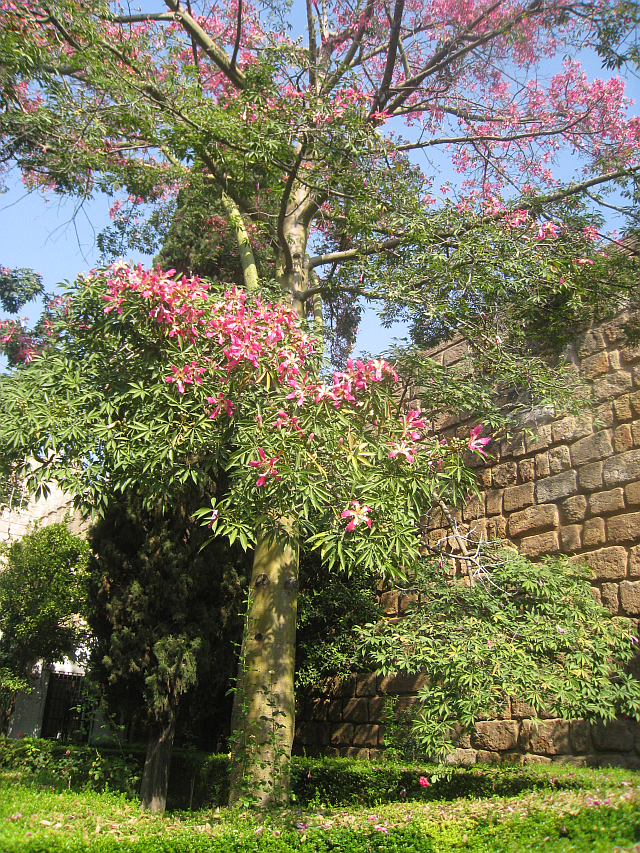
Apart from the monuments, the city itself is pretty cool.
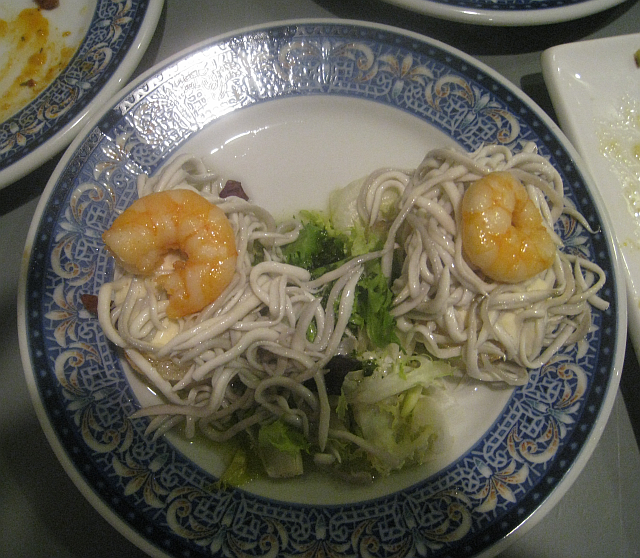
Naturally we had tapas. Now, you know how when you go to a restaurant the best dishes are always the starters? Well, the whole concept of tapas is that you eat only the starters! I.e. you order two or three dishes each, rather than a single main course. The range of dishes is huge. We had squid stuffed with roe, tenderloin steak with Roquefort cheese sauce, tenderloin with port wine, chicken breast stuffed with bacon and almond sauce, and even baby eels:
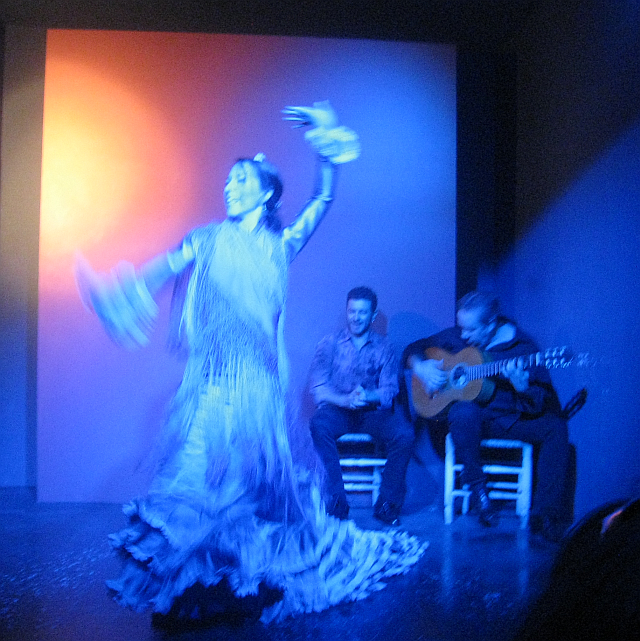
We also went to see a flamenco show. I didn’t realize how much tap dancing that involved. Don’t know how she avoids tripping over here dress.
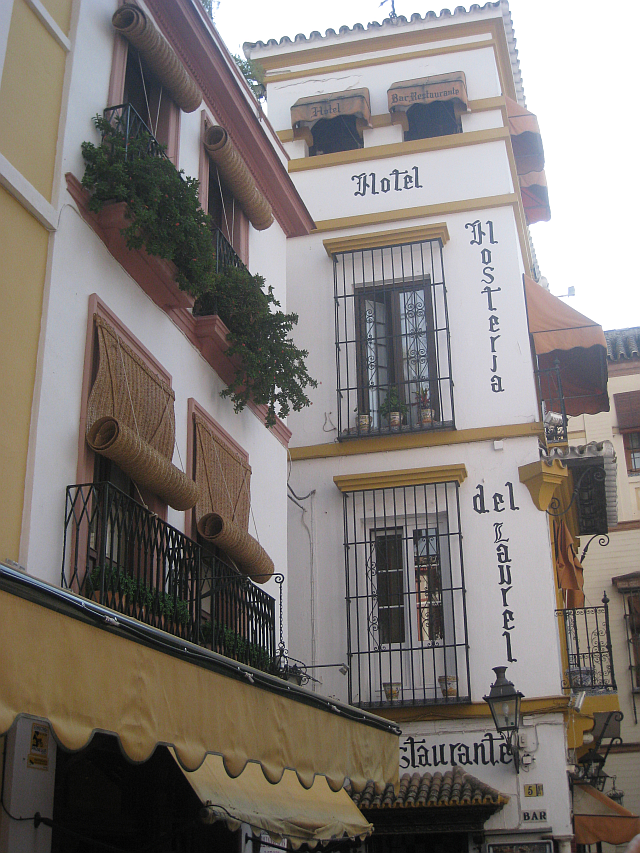
The streets in the old city are very narrow, often with shades way up high to keep the sun out. Now is apparently high season, as in the summer it gets over 40deg.
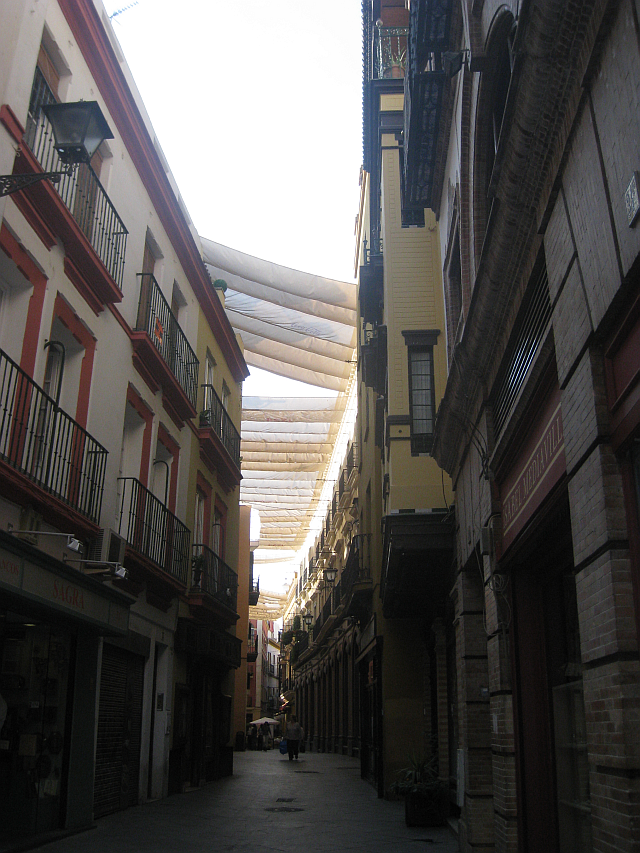
Many streets are pedestrian only, but others, no wider than the one above, allow cars through (just). Plus there are lots of motorbikes, bicycles, and horse-drawn carriages.

To keep the houses cool, the ancients used window shades that would be wetted, thus cooling the breeze as it entered the house:
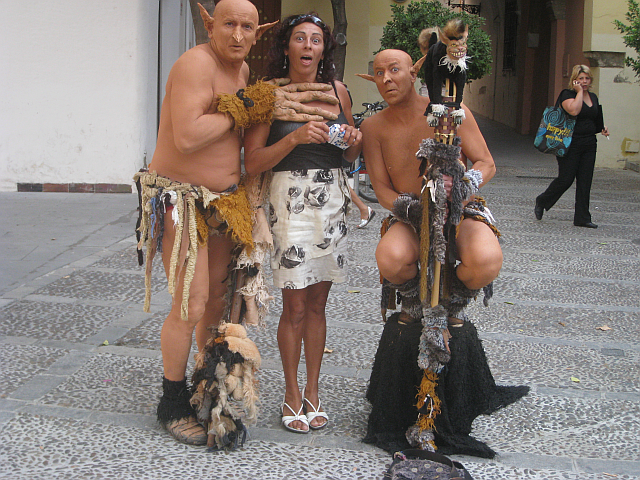
Along the way, Ceu was accosted by some gremlins.
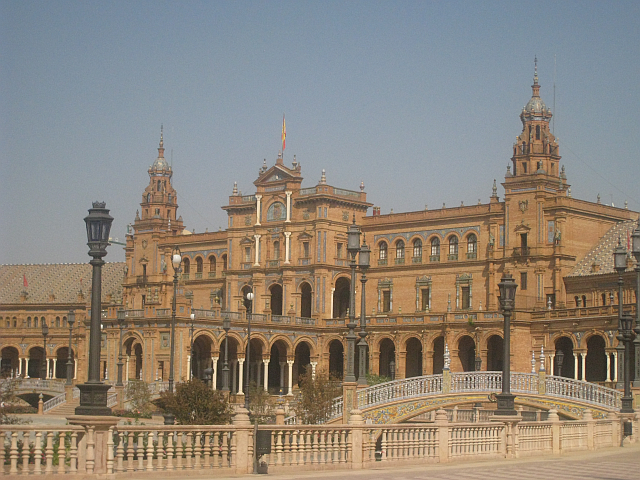
In 1929 the city put on a huge exposition, and built the Plaza del Espana which is enormous,
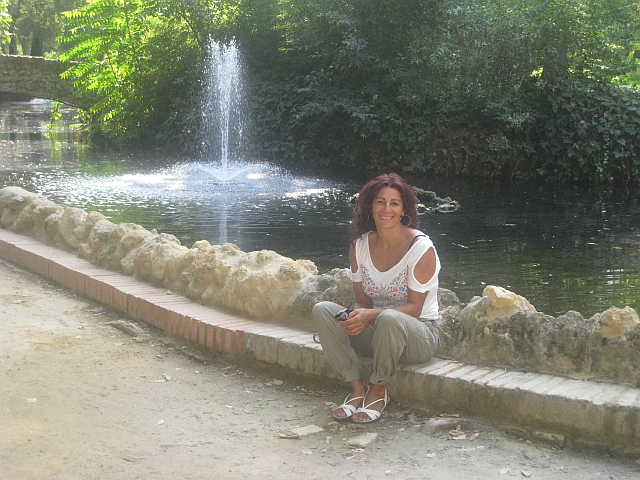
along with an even bigger botanical garden
Just a little way from the cathedral, but still within the old city walls, is a brand-new and very controversial building called the Metropol Parasol:
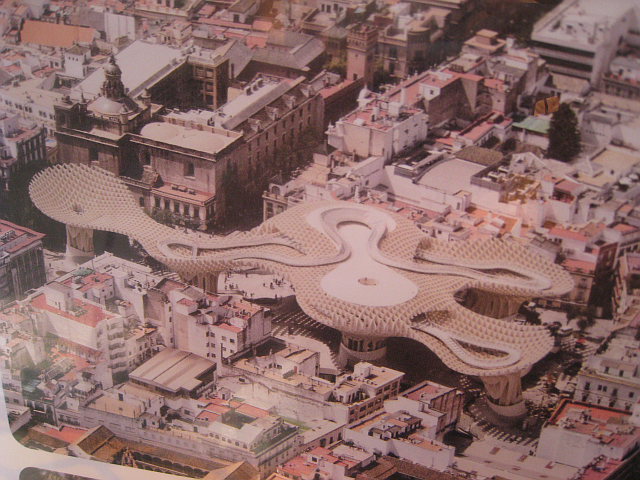
Many people think it is out of place in the historical city, but I thought it was cool.
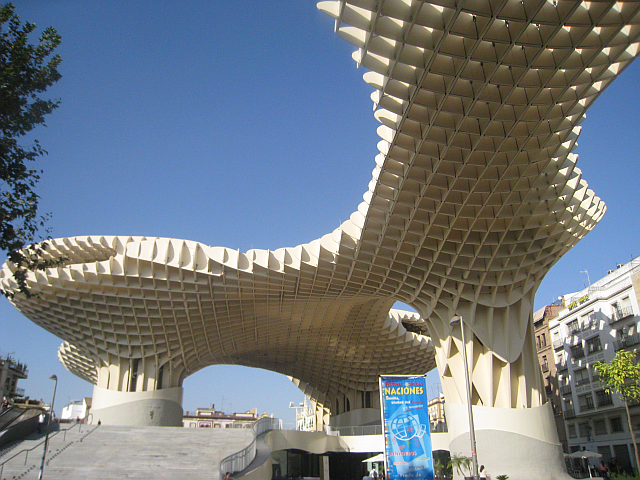
Underneath it is an excavation of a roman villa.
And it has a walkway across the top:
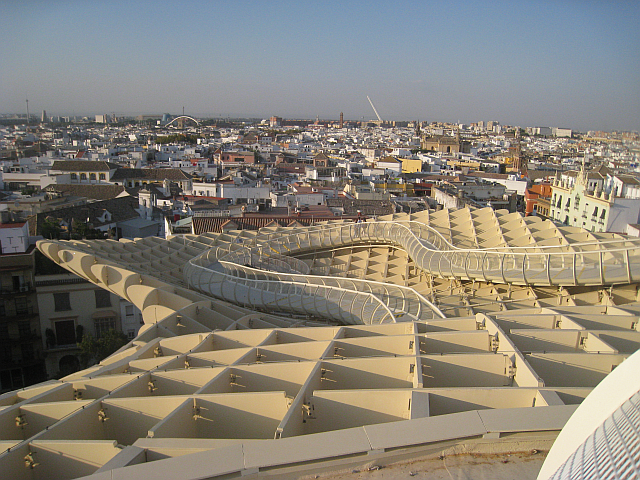
Three days is all you need to visit the city, and it is very easy to get around as everything is within a short walking distance. We recommend the walking tour to get acquainted with it. We thoroughly enjoyed our visit here.
This afternoon, when the tide changes, we will head back downstream towards Cadiz.
Sailing up Guadalquivir to Seville
Current Position: 37°2.17'N, 6°7.03'W
Distance sailed since last post: 20 nautical miles
Well..Sailing through the river was different from being at sea. The scenery through the 40 miles of the river was very different.
We started off through some very flat territory that looked almost like Holland. Gradually it became a bit more treed and then we started to see some hills inland.
We began at 2pm, just about at the turn of low tide right down at the entrance to the channel into Bonanza. The river is wide and easy. The channel deep.
Along the way we passed numerous fishing boats that looked like seaplanes with their booms out on each side. Many of them were junk, some were still operational, though often it was hard to determine their state.
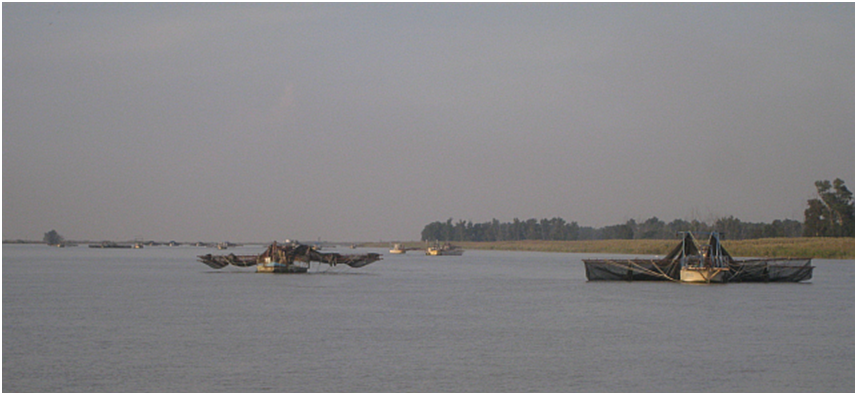
We thought we would see more traffic, but saw only one tanker that passed us on the way up, and then met us again the next day as they were coming down again.

Most of the way we motored, of course. But at times we were able to put up the jib to give us an extra boost. Of course then the wind would shift and the river bend, and then we would have to roll it up again.
Once the trees started we saw lots of birds (almost as many as in the Pantanal), and of course the usual cows and horses. But no alligators.
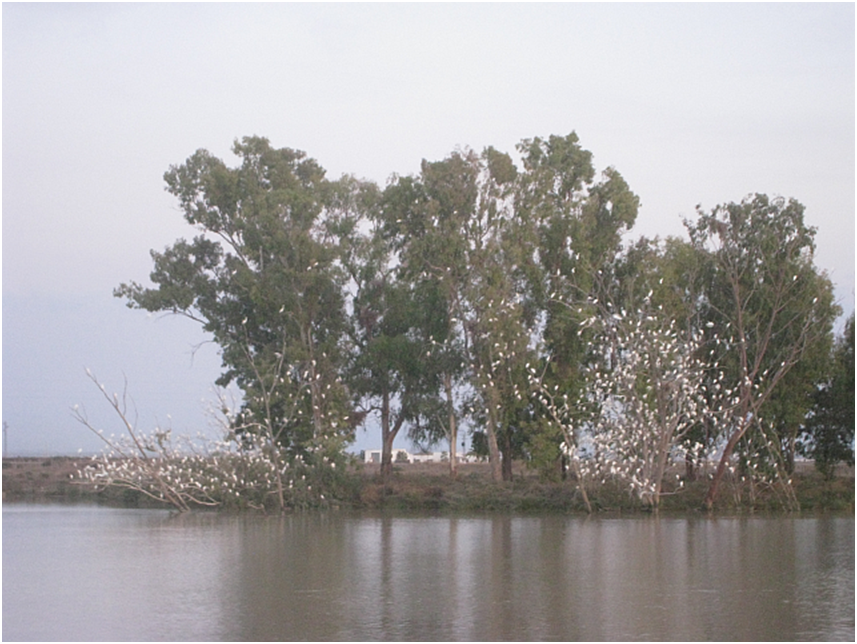
At 7pm it was getting dark, so we anchored along the side of the river at a spot that was a bit wider. That enabled us to do just the one anchor thing, which is a lot easier than two. We watched another spectacular sunset as huge fish were leaping two feet into the air. None leapt onto our boat, however, which would be the only way we would ever catch them!
The next morning we set off at 8am and got in a couple of hours before the tide changed. We then waited six hours for it to change again, and set off just before 4pm. At that time the tide was still against us a bit, but we wanted to get to Gelves before dark. It turns out that on the river the tide has 5 hours of flood, and 7 hours of ebb, so the return trip should be easy!
Just before Seville, the river branches. To the right are some fancy bright blue cantilever bridges that mark the entrance to the Canal de Alfonso XIII. This is the canal that runs right through Seville. However, it is a big procedure to actually get through it – it involves some locks, and bridges, and people who have to open bridges for you.
So we took the left hand branch. About a mile further up here is a little town called Gelves, with a tiny marina, and a nice place to anchor. Just beyond that is a low bridge, so that is as far as you can get anyway.
This is the little port of Gelves. It proved to be an excellent place to anchor, with easy accessibility to Seville by taking the 140 Bus right into town center. The return bus leaves from exactly the same stop as the one at which one gets of in town.
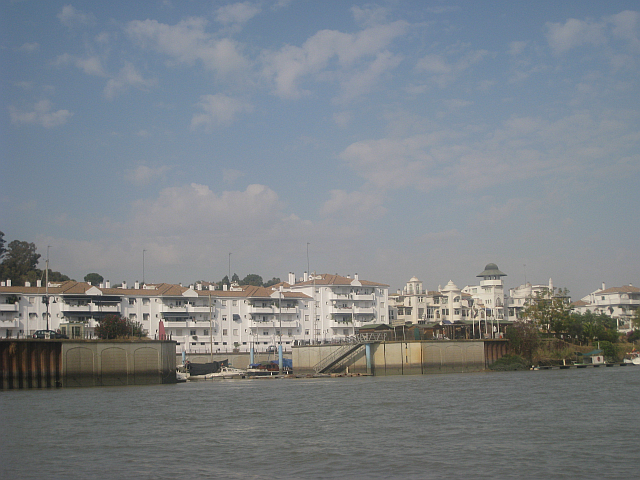
The Port of Gelves
We stopped there and went ashore. It was about 6:30 when we arrived, so that put our whole trip at about 7 ½ hours. Doesn’t seem to be much there, actually, but we did find a small supermarket, and right outside the marina is a café where we had some lamb chops for dinner and could finally use the internet.
Tomorrow we will go and explore Seville, which is just a bus ride away. We will update this when we have some new pictures.